


Have you ever taken the cover off your thermostat and been greeted by a rainbow of wires? It’s a little intimidating, right? Understanding thermostat wire colors can make simple home maintenance easier and help you know when it’s time to call in the pros. This guide is here to walk you through the basics in plain, safe, and practical terms.
Why Thermostat Wire Colors Matter
When it comes to controlling your heating and cooling system, thermostat wires act like messengers. Knowing what the colors mean can help you:
- Identify what each wire controls
- Avoid mistakes during light DIY tasks (like removing the thermostat for painting)
- Communicate clearly with HVAC pros if something goes wrong
What Thermostat Wires Do
Think of each thermostat wire as a messenger. Each color-coded wire carries a specific signal from your thermostat to your HVAC system. One tells it to heat, another to cool, and another to run the fan. They’re not just random wires—they’re how your thermostat speaks to your system.
Safety First: When to Call an Expert
Electricity and HVAC systems are no joke. If you’re unsure or uncomfortable, call a licensed HVAC technician.
Even touching the wrong wire during a simple fix could cause damage to your system, or worse, injury. For anything more than identifying or labeling wires, let the professionals handle it.
Even touching the wrong wire during a simple fix could cause damage to your system—or worse, injury. For anything more than identifying or labeling wires, let the professionals handle it.
Color Codes for Thermostat WiringThe Basic Thermostat Wire Color Code
Wire colors are a visual code to help identify their purpose. While wiring may vary, these are the most common color assignments:
The Main Colors and What They Control

- Red (R): Power supply (typically 24V from the transformer)
- White (W): Signals heating
- Yellow (Y): Controls cooling (A/C)
- Green (G): Controls the fan
- Blue or Black (C): Common wire (provides constant power to smart thermostats)
What Color is the Common Wire?
The C-wire is usually blue or black. It doesn’t control a specific function—it delivers steady power. If you’re installing a smart thermostat, this is the wire that keeps it running 24/7.
What are the A/C Specific Wire Colors?
For cooling-related functions:
- Yellow (Y): Sends a signal to the compressor to cool the air
- Green (G): Activates the blower fan to circulate air
These two wires are essential to your air conditioning system’s operation.
Detailed Breakdown of Thermostat Wire Colors and Functions
To give you a complete picture of how each terminal functions inside your wall, let us break down each individual conductor and what it controls within your heating and cooling network.
What Wire Color Is Hot on a Thermostat?
In your home outlets, the hot wire is usually black. But on a low-voltage thermostat, the red wire is the one carrying the live power.
This wire delivers 24 volts of electricity straight from your furnace or air handler transformer right up to the R, Rc, or Rh terminal on your wall plate. Because this wire stays energized whenever the power to your system is turned on, letting it bump against a metal screw, the blue wire, or the furnace cabinet can pop a small fuse on your control board. That is why turning off the breaker or the switch on the side of your furnace is always step one before checking behind the thermostat.
What Is Rc and Rh on a Thermostat?
Take a look at your thermostat backplate and you might see two red terminals labeled Rc and Rh:
- Rc (Red Cooling): Delivers power for your air conditioning system.
- Rh (Red Heating): Delivers power for your heating equipment.
If your home has a combined system, like a standard gas furnace paired with an outdoor central AC unit, one shared transformer runs both heating and cooling. In that case, a small metal jumper pin or a tiny piece of wire connects Rc and Rh so that a single red wire powers both modes.
If your home has two separate setups, like a boiler for winter heating and a completely separate attic AC unit for summer, you have two transformers. For that kind of system, you remove that jumper so the boiler wire goes to Rh and the AC wire goes to Rc, keeping the two power supplies separate and safe.
What Is the White Wire on a Thermostat?
The white wire connects to the W or W1 terminal. When your home starts feeling a little chilly, this is the wire that tells your furnace it is time to turn on the heat.
Once the temperature drops below your setpoint, your thermostat connects the red power wire to the white wire. That signal tells the furnace to start its ignition cycle and light the burners. If you have a two-stage furnace that kicks into a higher gear on extra cold winter days, you might also have a second white wire connected to W2.
What Is the Yellow Wire on a Thermostat?
The yellow wire attaches to the Y or Y1 terminal, and it is the key player when summer heat rolls in.
When you want to cool things down, your thermostat sends power down this yellow wire straight out to the contactor switch in your outdoor air conditioning unit. That signal tells the compressor and the big outdoor fan to start running and cooling your home. If your system has two cooling speeds, you might also see another yellow wire connected to Y2 for high-stage cooling.
What Is the Green Wire on a Thermostat?
The green wire connects to the G terminal, and it has one straightforward job: running the indoor blower fan.
Ever walk over to your thermostat and flip the fan switch from AUTO to ON just to get some fresh air moving through the rooms? When you do that, the thermostat sends power down the green wire to turn on the blower fan without turning on your AC compressor or furnace burners. When your AC is cooling normally, the thermostat activates the green wire and yellow wire together so chilled air circulates right away.
What Is the Blue Wire on a Thermostat?
The blue wire connects to the C terminal, which stands for Common wire.
Think of it this way: the red wire brings power to the thermostat, and the blue C-wire gives that electrical circuit a direct path back to the furnace. Old-fashioned dial thermostats didn’t need one because simple batteries or mechanical switches were enough. But modern smart thermostats with colorful screens and Wi-Fi connections need a steady flow of 24-volt power to stay awake around the clock, and the blue wire provides that steady power loop.
Where Does Blue Wire Go on Thermostat?
The blue wire plugs straight into the slot labeled C on your wall plate.
If you are setting up a new smart thermostat like a Nest, Ecobee, or Honeywell, putting the blue wire into that C terminal is what keeps the screen lit and the Wi-Fi connected without wearing out backup batteries.
One quick tip: just because there is a blue wire poking out of your wall doesn’t always mean it is connected on the other end. In many homes, installers tuck the blue wire back into the wall or leave it unattached at the furnace control board. If you plug it in and your new smart thermostat still stays dark, that blue wire probably just needs to be connected to the C terminal at the furnace.
What Is the Orange Wire on a Thermostat?
The orange wire connects to the O or O/B terminal, and you will usually only see it if your home is equipped with a heat pump.
A heat pump heats and cools by using a handy internal valve, called a reversing valve, that switches the direction of refrigerant flow between seasons. The orange wire carries the signal that tells that valve when to switch over. On most popular brands, the orange wire energizes the valve whenever you switch your system into cooling mode for the summer.
What Is the Brown Wire on a Thermostat?
The brown wire can wear a couple of different hats depending on what kind of equipment you have:
- Heat Pump Backup Heat: On heat pump systems, the brown wire usually goes to the Aux or E terminal. When outdoor temperatures drop well below freezing, this wire turns on backup electric heat strips to keep your living room toasty.
- Stand-In Common Wire: If your wire bundle didn’t include a blue wire, an installer may have used a brown wire as the 24-volt common wire to power a smart thermostat instead.
- Heating Changeover: On a few specific heat pump brands, a brown wire signals the reversing valve to switch into heating mode rather than cooling.
Heat Pump Thermostat Wire Colors Explained
If your home has a heat pump rather than a standard furnace and air conditioner combo, the wires on your backplate do slightly different jobs. Because a heat pump uses the exact same outdoor unit to heat your home in January and cool it in July, it relies on a few extra wires to control the reversing valve and backup heat strips.
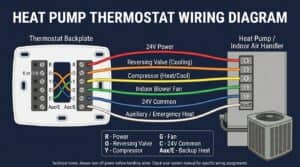
Here is a quick look at standard heat pump thermostat wire colors and what each one does:
- Red R: Powers the thermostat with continuous 24-volt current from the indoor air handler transformer.
- Orange O or O/B: Controls the reversing valve. In most systems, energizing this wire shifts the heat pump into cooling mode for the summer.
- Yellow Y: Activates the outdoor compressor. Unlike a standard gas furnace where yellow only runs during air conditioning, on a heat pump, the yellow wire turns on the compressor in both heating and cooling modes.
- Green G: Signals the indoor air handler blower fan to circulate conditioned warm or cool air through your supply vents.
- Blue C: Delivers the 24-volt common power loop that keeps smart thermostats and digital screens running uninterrupted.
- White or Brown Aux or E: Connects to auxiliary or emergency heat. When outdoor temperatures plunge into the teens and the outdoor heat pump needs help keeping up, this wire turns on electric resistance heat strips inside the air handler.
Wiring Diagram for AC Unit Thermostat
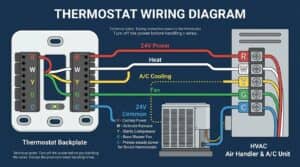
To visualize how these colorful conductors interact, here is a functional wiring diagram breakdown for a standard single-stage residential central air conditioning system paired with a gas furnace:
How the Operational Circuits Work
- Cooling Call Circuit: When your thermostat calls for cooling, it bridges power internally from R to both Y and G. The yellow wire energizes the outdoor condenser contactor to run the compressor and outdoor fan, while the green wire energizes the indoor blower to circulate chilled air across the evaporator coil and through your ducts.
- Heating Call Circuit: When your thermostat calls for heating, it bridges power internally from R to W. The white wire energizes the furnace control board to open the gas valve and spark the burners. Modern furnaces manage blower timing automatically; once the heat exchanger reaches a safe temperature, the furnace control board turns on the blower motor independently.
- Continuous Power Circuit: Power travels continuously from the transformer up the red R wire to power the thermostat processor, and returns along the blue C wire back to the transformer to complete the continuous low-voltage loop.
When You Should Seek Professional Help with Your Thermostat Wiring
Even if wire colors help guide you, modern HVAC systems can still get complicated. Certain systems have additional wires, multiple stages, or unique requirements. That’s when it’s time to call in the experts.
Heat Pumps Wiring
Heat pumps often use different wire configurations and may include orange or brown wires for reversing valves and auxiliary heat. If you see these—or anything unfamiliar—call a pro. These systems require specialized knowledge to wire correctly.
Advanced or Multi-Staged Systems
If your system offers different levels of heating or cooling (multi-stage), you’ll likely have additional wires like W2 or Y2. These setups go beyond basic thermostat wiring and should always be handled by licensed HVAC professionals.
Simple Tips for Homeowners
If you’re just doing something like taking off your thermostat to paint a wall or switch out the faceplate, here are a few things you can safely do:
Taking Pictures and Labeling
Before removing any wires:
- Take a clear photo of how everything is connected
- Use masking tape or wire labels to mark each wire (match colors to letters: R, W, Y, G, C, etc.)
This will make it much easier to reconnect everything exactly as it was.
Simple DIY Thermostat Wiring Checks
- Gently tug each wire to make sure it’s secure.
- Check for corrosion or dust buildup and clean with a soft cloth.
- Never attempt to cut, splice, or move wires unless you’re trained.
When in doubt—stop and call a professional.
Contact Meyer Heating and Air for Professional Assistance
Do not risk damaging your heating and cooling equipment with improper DIY smart thermostat wire changes. The team at Meyer Heating & Air provides detailed calibrations and wiring assessments to guarantee seamless system communication. Whether you need reliable heating and cooling services in Affton or specialized HVAC services in Sunset Hills, we are ready to assist.
Call Now: (314) 845-1929 | Text Us: (314) 845-1929 | Schedule Online
We’re happy to help with everything from diagnosing thermostat issues to full HVAC installations.
Frequently Asked Questions
What happens if you connect thermostat wires incorrectly?
Connecting thermostat wires to the wrong terminals can trigger immediate electrical faults. Crossing the hot red wire R with the common wire C creates a direct short circuit that blows the low-voltage fuse on your indoor control board or destroys the step-down transformer. Connecting the yellow cooling wire Y to the heating terminal W will cause your furnace burners to ignite when you call for air conditioning.
Can a thermostat work without a blue C-wire?
Basic mechanical thermostats and digital models powered by disposable AA alkaline batteries function normally without a C-wire. However, modern smart Wi-Fi thermostats require continuous 24-volt power to run digital touchscreens and maintain network connectivity. Some smart models attempt to power-steal through the heating or cooling wires without a C-wire, which frequently causes equipment short cycling, humming contactors, and damaged furnace control boards.
What should I do if my thermostat wire colors do not match the standard?
Never guess based on color alone. If your wires do not match standard conventions, walk to your indoor furnace or air handler, remove the blower access door, and look at the low-voltage terminal strip on the printed control board. Note which colored wire connects to the R, C, Y, W, and G terminals at the equipment board, and match those exact connections at your wall thermostat.
Why are there two red terminals (Rc and Rh) on my thermostat?
Rc stands for Red Cooling, and Rh stands for Red Heating. Homes with a single integrated system share one transformer, utilizing a small metal jumper to link Rc and Rh together. Homes with two separate systems, such as a boiler for winter heat and a separate central AC unit for summer cooling, have two transformers, requiring the jumper to be removed so each red wire connects to its dedicated terminal.