

Estimated reading time: 10 minutes
When soaring summer temperatures hit your neighborhood, your central air conditioner works hard to keep your home cool and refreshing. Inside the metal outdoor condensing unit sits a small, cylindrical component that plays a massive role in whether your cooling system starts up at all: the air conditioner capacitor.
While capacitors are relatively small and inexpensive compared to heavy mechanical parts like compressors or evaporator coils, they are among the most frequent points of failure in residential air conditioning systems. When a capacitor begins to degrade or fails entirely, your air conditioner will struggle to start, make unusual humming noises, or blow warm air through your vents.
In this comprehensive guide, we will break down what an AC capacitor does, explore what happens to your system when a capacitor goes bad, detail the top warning signs of a failing capacitor, explain how to tell a bad capacitor from a bad compressor, outline replacement costs, and explain the proper steps to fix it safely.
What Does an AC Capacitor Do?
An air conditioning capacitor functions like a temporary, high-voltage battery. It stores electrical energy and releases it in precise bursts to start and operate your system electric motors.
Central air conditioning systems rely on two main motor circuits in the outdoor unit: the compressor motor, which pumps refrigerant, and the condenser fan motor, which exhausts heat into the outside air. Starting these heavy motors requires significantly more electrical current than standard household wiring can supply in a split second.
HVAC systems use two types of capacitors to manage this electrical workload:
- Start Capacitors: These supply a large surge of stored voltage to give the compressor motor the initial torque needed to break mechanical inertia and start spinning. Once the motor reaches operating speed, the start capacitor disconnects from the circuit.
- Run Capacitors: These supply a continuous, steady stream of electrical current to maintain an optimal phase shift and keep both the compressor and fan motors running smoothly throughout the entire cooling cycle. Many residential systems use a dual-run capacitor, which combines the circuits for both the fan motor and the compressor into a single metal canister.
What Does a Bad Capacitor Do to an AC Unit?
When an AC capacitor weakens or fails, it disrupts the electrical supply feeding your system motors. An electrical capacitor is rated in microfarads, which measures its ability to hold an electrical charge. As heat, electrical surges, and age degrade the internal dielectric fluid and foil layers, the microfarad output drops below manufacturer tolerance levels.
When this happens, the capacitor can no longer deliver sufficient voltage to start or sustain the motors:
- Motor Stalling and Overheating: Without adequate startup torque, the compressor or fan motor attempts to pull excessive current directly from the electrical panel. The motor hums, overheats rapidly, and fails to spin.
- Tripped Safety Overloads: As internal temperatures inside the motor windings spike, built-in thermal overload switches trip to prevent the motor from burning out, abruptly terminating the cooling cycle.
- Severe Mechanical Strain: Repeatedly forcing an electric motor to start with low voltage places intense mechanical friction on internal bearings and valves, drastically accelerating wear on your most expensive cooling equipment.
Will a Bad Capacitor Cause an AC to Not Cool?
Yes, a bad capacitor is one of the most common reasons an air conditioner stops cooling your home.
When a run capacitor fails completely, the compressor motor cannot turn on. However, your indoor air handler and blower fan sit on a separate electrical circuit inside your home. The indoor fan will continue to blow air through your supply registers, but because the outdoor compressor is not pumping refrigerant, that air will feel lukewarm or room temperature.
In other cases, a dual-run capacitor may fail only on the fan terminal while the compressor side still attempts to run. Without the outdoor fan spinning to dissipate heat, head pressures inside the refrigeration lines skyrocket within minutes, triggering a high-pressure safety lockout that stops the compressor from cooling.
Can a Bad AC Capacitor Cause a High Electric Bill?
Yes, a failing AC capacitor can cause a noticeable spike in your monthly electric bill.
When an electrical capacitor loses capacitance, the motors it powers must work substantially harder to spin. The compressor and fan motors draw excessive electrical amperage to compensate for the weak phase shift, consuming far more kilowatt-hours per hour of operation.
A weak capacitor often causes an air conditioning system to short cycle or run extended, inefficient cycles. If the system struggles to complete a full cooling run, it repeatedly draws high locked-rotor startup amperage without effectively lowering your indoor temperature, resulting in wasted electrical energy.
6 Signs Your AC Capacitor Is Bad
Air conditioning capacitors typically provide audible, visual, and operational warning signals before failing completely. Here are the primary symptoms that tell you an AC capacitor is bad.
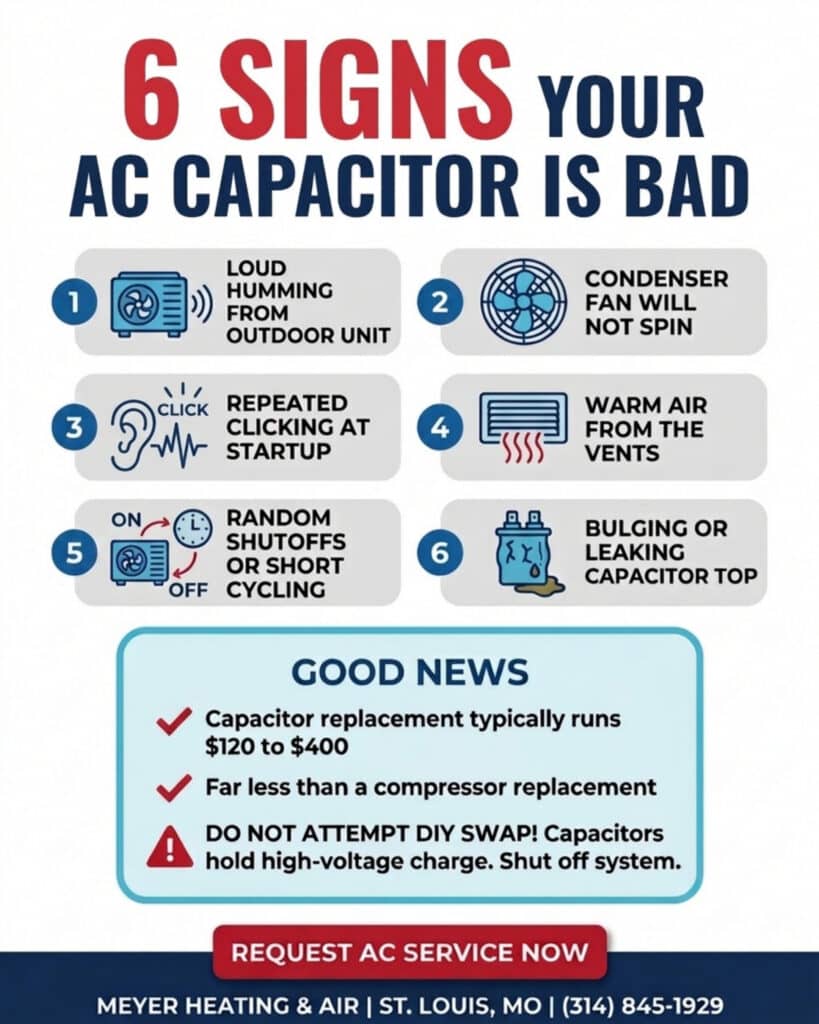
1. Loud Humming or Buzzing from the Outdoor Unit
When a capacitor lacks the electrical energy to turn the compressor or fan motor, the motor remains locked in place while electrical current continues flowing into the windings. This creates a distinct, loud humming or buzzing sound from the outdoor cabinet as the motor struggles against mechanical resistance.
2. Outdoor Condenser Fan Will Not Spin
If the outdoor fan blades sit motionless while you hear electrical humming, or if the fan only spins after being gently pushed with a long wooden dowel, the fan capacitor has lost its starting capacitance. The motor has power, but it lacks the phase-shifting torque required to start rotating on its own.
3. Clicking Sounds Upon Startup
When your thermostat calls for cooling, the outdoor contactor switch closes with an audible click. If you hear repeated clicking sounds followed by silence or a brief hum without the system kicking on, the capacitor is failing to release the voltage needed to engage the compressor motor.
4. Air Conditioner Blowing Warm Air Indoors
If your indoor vents are blowing strong airflow that feels room temperature or hot, the indoor blower is active while the outdoor compressor sits idle. A failed run capacitor prevents the compressor from circulating chilled refrigerant through your indoor evaporator coil.
5. AC Shuts Off Randomly or Short Cycles
A degrading capacitor can cause intermittent cooling cycles. As the capacitor heats up during hot afternoons, its electrical capacitance drops further, causing the compressor to stall mid-cycle. Once the equipment cools down, it may restart briefly before shutting down again.
6. Bulging, Swollen, or Leaking Capacitor Top
A healthy capacitor features a completely flat metal top with terminal prongs. When internal dielectric fluid breaks down and produces gas pressure, the top of the metal canister bulges outward like an overfilled soda can. In severe cases, oily dielectric liquid leaks around the terminal posts. Any visible bulging or leaking indicates immediate, irreversible capacitor failure.
How to Tell If an AC Compressor Is Bad vs. Capacitor
Because a bad capacitor prevents the compressor from running, homeowners often worry that their entire compressor has suffered an expensive, fatal breakdown. Differentiating between a failing capacitor and a dead compressor is a crucial diagnostic step.
Signs the Problem Is the Capacitor
- Visual Deformity: The capacitor shows a swollen top, a domed casing, or leaking oil.
- Low Microfarad Readings: Testing the capacitor terminals with a digital multimeter reveals a capacitance reading that is more than five to ten percent below the rating stamped on the metal case.
- Normal Motor Resistance: Testing the compressor electrical terminals reveals normal internal winding resistance without an open circuit or electrical short to ground.
- Immediate System Recovery: Installing a fresh, correctly rated capacitor allows the compressor to start up smoothly and pull normal operating amperage.
Signs the Problem Is the Compressor
- Capacitor Tests Perfectly: The capacitor measures within its exact microfarad tolerance, yet the compressor still refuses to start.
- Tripped Breakers on Startup: The compressor immediately trips the high-voltage double-pole circuit breaker the exact second it attempts to start, signaling grounded internal motor windings.
- Locked Rotor Amperage: The compressor hums loudly and draws locked-rotor amperage, which is often three to five times higher than normal running load amps, even when tested with a brand-new capacitor and an auxiliary hard-start kit.
- Acidic Refrigerant Odor: A burned-out compressor motor contaminates the refrigeration loop, creating a strong acidic smell during refrigerant pressure testing.
Because testing a capacitor costs significantly less than replacing a compressor, technicians always test and verify capacitor performance before diagnosing a failed compressor.
How Long Will an AC Run with a Bad Capacitor?
An air conditioner cannot run normally with a completely dead capacitor. If the run capacitor has failed, the compressor will not turn on at all, meaning your home will receive no cooling.
If the capacitor is merely weak and out of tolerance, the air conditioner may continue to start and run for a few days or weeks, but doing so carries immense risks:
- Compressor Motor Burnout: Running a motor on low voltage forces the windings to operate at extreme temperatures. Overheating cooks the internal enamel insulation, causing the motor to short out and destroying a compressor that could have lasted years longer.
- Melted Wiring and Contactors: The excessive electrical current drawn by a struggling motor can melt wiring terminals and fuse contactor points together, creating fire hazards inside the electrical compartment.
If you suspect your capacitor is degrading, shut your system off at the thermostat immediately to protect your equipment from permanent motor damage.
How to Fix a Bad AC Capacitor
Fixing a bad air conditioning capacitor is not a simple do-it-yourself project. While replacement parts are relatively inexpensive, working inside an outdoor condenser involves serious safety risks and strict technical tolerances.
Capacitors store dangerous high-voltage electrical charges long after the power has been shut off at the breaker. Discharging this stored energy improperly can lead to severe electrical shocks or equipment damage.
Because of these electrical hazards, hiring a licensed professional like Meyer Heating and Air is the safest, most cost-effective choice. A certified HVAC technician does more than simply swap out a part. Technicians safely discharge residual voltage, use calibrated digital multimeters to test microfarad ratings against manufacturer specs, and inspect the electrical contactor for pitted contact points.
Cost of Replacing a Capacitor on an Air Conditioner
The cost to replace an air conditioner capacitor is one of the most affordable repairs in residential HVAC service.
On average, the total cost for professional capacitor replacement ranges from one hundred and twenty to four hundred dollars. The final price depends on a few specific variables:
- Capacitor Type: A basic single-run capacitor for a fan motor costs less, while a heavy-duty dual-run capacitor designed for high-tonnage scroll compressors sits higher in the price spectrum.
- Component Quality: Standard consumer-grade capacitors carry basic warranties, while commercial-grade capacitors built with thicker dielectric fluid and higher operating temperature ratings provide longer service life for a modest additional charge.
- Diagnostic Labor and Testing: The total service invoice includes professional diagnostic testing, electrical discharge, safe removal, testing of motor running amperage, and inspection of contactor contact points to ensure the electrical circuit operates within factory limits.
Attempting DIY capacitor replacement without proper training carries substantial electrical shock risks and can result in improper wiring that permanently destroys the compressor motor.
Restore Safe, Reliable Cooling with Meyer Heating and Air
At Meyer Heating and Air, our certified technicians bring decades of hands-on technical craftsmanship to every residential comfort challenge. If your air conditioner is struggling to start or blowing warm air, our local team provides prompt, dependable ac repairs in Ladue and comprehensive cooling services in Town and Country. We arrive quickly, test your electrical capacitance and motor amperages, replace failing components with premium commercial-grade parts, and restore reliable, balanced comfort to your home.
Contact Meyer Heating and Air today to schedule your air conditioning diagnostic or capacitor replacement appointment and keep your cooling system running strong!
Frequently Asked Questions
Can an AC run without a capacitor?
No. Permanent split-capacitor motors and scroll compressors used in residential central air conditioning require the phase shift and starting torque provided by capacitors to begin spinning and sustain rotation. Without an operational capacitor, the motors cannot turn.
What causes an AC capacitor to fail?
Capacitors fail primarily due to intense summer heat exposure, continuous voltage fluctuations, lightning strikes, power surges, and natural component aging. Operating an air conditioner with dirty outdoor coils forces the system to run hotter and longer, significantly shortening capacitor lifespan.
How many years does an AC capacitor last?
On average, an air conditioner capacitor lasts between five and ten years. In climates with long, humid cooling seasons and intense summer heat waves, capacitors experience heavier thermal stress and may require replacement every three to five years.
Can I replace an AC capacitor myself?
While replacement parts can be purchased online, DIY capacitor replacement is dangerous. Capacitors store high-voltage electricity that can cause severe shock or electrocution even when the main breaker is off. Furthermore, connecting wires to the wrong terminals can instantly burn out your compressor motor. Professional HVAC technicians possess the proper safety gear and diagnostic meters to complete the job safely.