

When summer heat settles over the region, you rely on your central air conditioning system to keep your living spaces crisp, cool, and relaxing. Walking past a supply register only to feel a blast of lukewarm or hot air blowing across your skin is an alarming experience for any homeowner.
An air conditioning system is engineered to circulate chilled, dehumidified air throughout your home. When it begins blowing hot air instead, the breakdown can stem from something as simple as an accidental thermostat switch or as serious as a failing compressor or severed refrigerant line.
In this comprehensive diagnostic guide, we will explain what it means when your AC blows hot air, answer whether the outdoor unit should blow hot air, break down the primary causes behind warm airflow, explore why systems blow hot air intermittently, and outline the steps required to restore balanced cooling to your home.
What Does It Mean When Your AC Blows Hot Air?
To understand why an air conditioner blows warm air, it helps to understand how central cooling functions. A common misconception is that air conditioners create cold air from scratch. In reality, an air conditioner is a heat-removal appliance.
Your system operates through a closed-loop refrigeration cycle:
- The indoor evaporator coil absorbs heat and moisture from your indoor air as it passes through the return ductwork.
- The chemical refrigerant carries that thermal energy outdoors through insulated copper lines.
- The outdoor condenser unit compresses the refrigerant and expels that indoor heat into the outdoor air.
- The chilled, conditioned air is pushed back through your supply registers and into your living rooms.
When your AC begins blowing hot air, it means this heat-removal cycle has broken down. Either the indoor blower fan is moving air across a coil that cannot absorb thermal energy, or the outdoor unit is failing to discharge that heat outdoors.
Is the AC Unit Outside Supposed to Blow Hot Air?
Yes, your outdoor air conditioning unit is supposed to blow hot air. In fact, strong, hot air blowing upward from the top of the outdoor fan is a clear sign that the system is doing its job correctly. That hot exhaust air is the thermal energy the system pulled out of your bedrooms, living room, and kitchen.
However, if your indoor vents are blowing hot air and the air coming out of the top of your outdoor unit is cool or room temperature, that indicates a major system failure. Cool air from the outdoor condenser means the compressor is not running, the refrigerant is not circulating, or the system has lost its charge, preventing heat from being extracted from inside your home.
7 Reasons Your AC Is Blowing Hot Air Inside
When an air conditioner blows warm air indoors, technicians inspect several failure points across your electrical controls, airflow paths, and refrigeration lines. Here are seven primary reasons your air conditioner is blowing hot air.
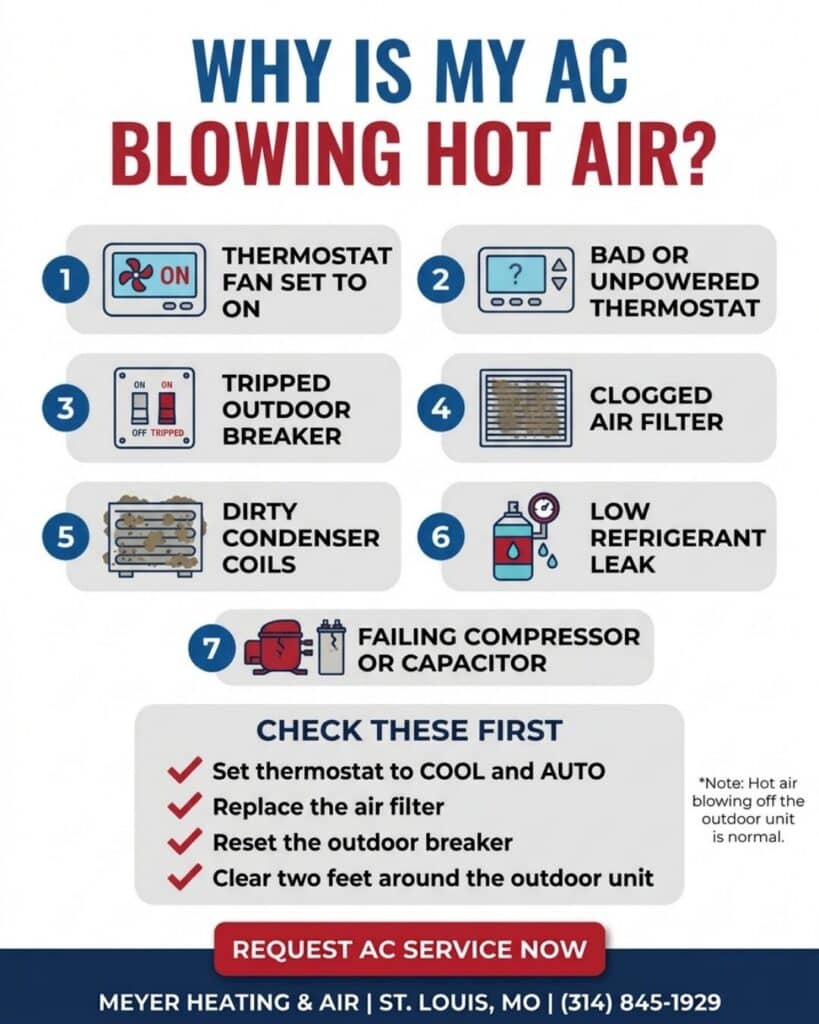
1. Thermostat Set to ON Instead of AUTO
The simplest and most frequent cause of warm air blowing from your vents is an incorrect fan setting on your thermostat. Thermostats feature two primary fan options: AUTO and ON.
When set to AUTO, the indoor blower fan runs only while the outdoor compressor and cooling coils are actively chilling the air. When your home reaches the target temperature, both the blower and the outdoor unit shut down together.
When the fan switch is set to ON, the indoor blower fan runs continuously twenty-four hours a day, even when the outdoor condenser cycles off. Between cooling cycles, the fan blows unconditioned, room-temperature air through your registers, which can feel uncomfortably warm and drafty during hot afternoons. Switching the setting back to AUTO solves the issue immediately.
2. Bad, Miscalibrated, or Unpowered Thermostat
Can a bad thermostat cause an AC to blow hot air? Absolutely. Your thermostat serves as the central control board for your entire cooling system. If the internal sensors become uncalibrated, the batteries die, or the internal low-voltage wiring loosens, the device can send incorrect signals to your equipment.
In many cases, a faulty thermostat signals the indoor air handler to blow air while failing to send the 24-volt start command to the outdoor condenser contactor. The indoor fan will blow room-temperature air throughout your home while the outdoor unit sits completely silent.
3. Tripped Outdoor Circuit Breaker or Blown Fuse
Central air conditioning systems use two separate electrical circuits: one for the indoor air handler and furnace blower, and a high-voltage double-pole circuit for the outdoor condenser.
If a sudden power surge, lightning strike, or electrical overload trips the breaker powering the outdoor unit, the indoor blower will keep running normally because it sits on a separate circuit. The indoor fan will circulate warm household air through your ducts, but without the outdoor compressor and fan running, no cooling can take place.
4. Dirty and Clogged Air Filter Choking Airflow
A heavily restricted air filter coated in thick dust, pet dander, and household lint suffocates your air handler. When airflow across the indoor evaporator coil is severely restricted, the refrigerant inside the tubing cannot absorb sufficient heat from your indoor air.
As system pressure drops, the moisture on the cooling coil freezes into a solid block of ice. Once the coil is encased in ice, air cannot pass through the metal fins. The air that manages to squeeze past the edges arrives at your supply vents as weak, lukewarm air while the system runs continuously.
5. Heavily Soiled Outdoor Condenser Coils
Your outdoor condenser coil consists of hundreds of delicate aluminum fins that dissipate heat into the outside atmosphere. Over months of spring and summer operation, cottonwood seeds, lawn clippings, leaves, and airborne dust coat the exterior fins.
When the condenser coil is buried under a blanket of dirt, heat cannot escape into the outdoor air. The refrigerant remains hot, head pressures spike inside the compressor, and the internal thermal overload safety switch trips. This forces the compressor to shut down while the indoor fan continues blowing unconditioned air inside.
6. Low Refrigerant Levels Due to a System Leak
Your air conditioner requires a specific, hermetically sealed volume of chemical refrigerant to transport thermal energy. Air conditioners do not consume or burn refrigerant like gasoline in a car; the same refrigerant circulates continuously for decades.
If corrosion, vibration, or physical damage creates a pinhole leak in the copper tubing or service valves, system pressure drops. As refrigerant escapes, the system loses its physical capacity to absorb heat from indoor air. The indoor vents will blow warm or lukewarm air, and ice may form along the refrigerant lines connecting to the outdoor unit.
7. Failing Compressor or Weak Run Capacitor
The compressor is the mechanical heart of your air conditioning system, responsible for pumping refrigerant between the indoor and outdoor coils. Mounted next to the compressor is a cylindrical run capacitor that supplies the continuous electrical voltage needed to keep the motor spinning.
If the capacitor weakens and loses its electrical capacitance, the compressor motor will overheat and stall. If the compressor itself suffers internal valve failure or electrical burnout, it can no longer compress the refrigerant gas. The outdoor fan may still spin, but without an operating compressor, the system will only blow hot air through your indoor vents.
Why Does My AC Intermittently Blow Hot Air?
If your cooling system alternates unpredictably between cold air and warm blasts, the system is struggling with an intermittent operational fault:
- Short Cycling from System Overheating: If your outdoor condenser coils are caked with dirt, the compressor overheats, trips its thermal safety cutoff, and stops cooling. Once the compressor cools down thirty minutes later, it restarts and blows cold air again until it overheats once more.
- Cycling Evaporator Coil Freeze-Ups: A restricted air filter or low refrigerant charge can cause the indoor coil to freeze into a block of ice, turning your supply air warm. When the system shuts down, the ice melts, allowing the system to blow cold air for a short time before freezing over again.
- Failing Electrical Relays and Capacitors: Electrical capacitors and contactor switches can behave erratically as they approach complete failure, dropping electrical connections intermittently when outdoor temperatures peak.
Why Is the AC Blowing Cold Air But the Room Is Still Hot?
In some scenarios, you place your hand in front of a supply register and feel distinctly cold air, yet the room itself remains hot and uncomfortable. This issue usually points to air distribution problems rather than mechanical refrigeration failures:
- Massive Ductwork Leaks: If supply duct runs pass through an unconditioned attic space that reaches one hundred and thirty degrees in the summer, torn seams or disconnected flexible ducts will dump chilled air into the attic while pulling scalding attic air directly into your living spaces.
- Unbalanced Airflow and Closed Vents: Closing supply vents in unused rooms increases static pressure, which forces chilled air to escape through tiny duct seams instead of reaching distant bedrooms.
- Intense Solar Heat Gain: Rooms with large south-facing or west-facing windows absorb continuous radiant heat from the afternoon sun. If window blinds are left open and the ductwork delivers only standard airflow, the cooling capacity cannot overcome the heavy radiant heat load.
- Undersized Cooling Equipment: If an air conditioner was sized too small for your home square footage, it will blow cold air continuously but lack the total British Thermal Unit capacity to lower the room temperature on extremely hot days.
Immediate Troubleshooting Checklist for Homeowners
Before scheduling an emergency AC service call, run through these straightforward troubleshooting steps:
Step 1: Verify Thermostat Settings
Walk to your thermostat and confirm that the system switch is set firmly to COOL and the temperature setpoint is at least three to five degrees below the current room reading. Verify that the fan switch is set to AUTO rather than ON.
Step 2: Replace the Air Filter
Slide the air filter out of the return grille or air handler slot. If the filter is dark, dusty, or coated in pet dander, install a brand-new filter immediately. If the indoor coils have iced over, leave the system turned off for several hours with the fan set to ON to allow the ice to melt completely.
Step 3: Inspect Electrical Circuit Breakers
Locate your main electrical panel and check the dual-pole breaker labeled AC, Condenser, or Heat Pump. If the breaker switch sits in the neutral or OFF position, reset it by flipping it all the way OFF and then firmly back to ON.
Step 4: Check the Outdoor Condenser Cabinet
Walk outside and inspect the outdoor unit. Verify that the fan blades are spinning and that warm exhaust air is rising from the top. Clear away tall grass, weeds, leaves, and outdoor storage items to maintain at least two feet of open clearance around the metal cabinet.
Restore Dependable Cooling with Meyer Heating and Air
At Meyer Heating and Air, our certified technicians bring decades of hands-on craftsmanship to every cooling challenge. If your air conditioner is blowing hot air or running continuously without cooling, our local team provides prompt, dependable ac repairs in Ballwin and comprehensive cooling services in Chesterfield. We arrive quickly, test your electrical controls and refrigerant pressures, identify the exact root cause of the breakdown, and deliver lasting repairs that restore crisp, dependable comfort to your household.
Contact Meyer Heating and Air today to schedule your air conditioning diagnostic appointment and enjoy cool comfort all summer long!
Frequently Asked Questions
Can a bad thermostat cause an AC to blow hot air?
Yes. A bad, uncalibrated, or dead-battery thermostat can fail to send the low-voltage start signal to your outdoor condenser unit. When this occurs, the indoor furnace fan runs continuously, blowing uncooled room-temperature air through your vents while the cooling equipment outside remains completely inactive.
Should the AC unit outside blow hot air?
Yes. The outdoor unit is designed to release the heat that was extracted from inside your home. If your cooling system is operating properly, the air blowing upward from the outdoor condenser fan should feel noticeably hot. If that air feels cool while your indoor vents blow warm, the compressor is not running or the system has lost its refrigerant charge.
Is it safe to run my AC if it is blowing warm air?
No. If your air conditioner is blowing warm air, you should turn the system to OFF at the thermostat immediately. Running the equipment while the coils are frozen, airflow is choked, or refrigerant is low can cause irreversible mechanical damage to the compressor motor, turning an affordable component repair into an expensive full system replacement.
Why is my AC blowing hot air after a power outage?
During a power outage or electrical surge, high-voltage breakers can trip, or the outdoor unit safety time-delay relay may activate. Many modern systems incorporate a built-in three to five minute delay to protect the compressor from short-cycling after power is restored. If the unit still blows warm air after fifteen minutes, check your main breaker panel or contact a certified technician to inspect the run capacitor.