

Estimated reading time: 8 minutes
Have you ever wondered how a single system can keep your home warm in the winter and cool in the summer? A heat pump is a highly efficient HVAC option that does exactly that. By transferring heat rather than generating it from fuel, heat pumps can save you money and keep your home comfortable year-round.
This guide breaks down how these systems work, identifies their key components with easy-to-understand diagrams, and highlights the differences between air-source and geothermal systems.
What Is a Heat Pump and How Does It Work?
Unlike furnaces that create heat by burning natural gas or oil, or electric baseboard heaters that generate heat through resistance, a heat pump does not actually create heat. Instead, it works by moving heat from one place to another using a refrigerant cycle.
In the summer, it acts like a standard air conditioner, absorbing heat from inside your home and releasing it outdoors. In the winter, the process reverses: the system absorbs heat from the outdoor air (even in very cold temperatures) and brings it inside. Because moving heat requires far less energy than creating it, heat pumps are incredibly efficient.
Heat Pump Component Diagram
Understanding the anatomy of your HVAC system is the first step in recognizing how it keeps your home comfortable. Let’s start with the physical parts that make up a standard split-system heat pump.
Key Components of a Heat Pump System
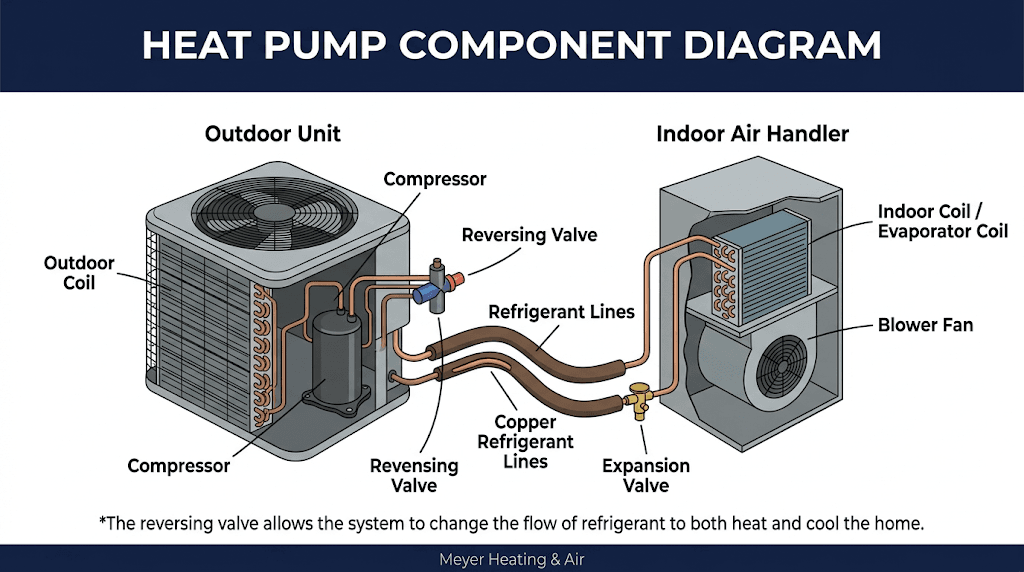
A typical air-source heat pump consists of an indoor unit (the air handler) and an outdoor unit (the condenser), connected by a closed loop of copper refrigerant lines.
Here is a breakdown of the critical parts shown in the diagram:
- Outdoor Unit: The large metal cage located outside your home. It houses the compressor, outdoor coil, and a large fan.
- Compressor: Often called the heart of the system. Located in the outdoor unit, it pumps refrigerant through the system, compressing it to raise its temperature and pressure.
- Reversing Valve: The most critical component unique to heat pumps. This valve switches the direction of the refrigerant flow, allowing the system to transition between heating and cooling modes.
- Outdoor Coil: In cooling mode, this acts as a condenser to release heat. In heating mode, it acts as an evaporator to absorb heat from the outdoor air.
- Indoor Air Handler: Located inside your home (such as in a basement, attic, or utility closet). It houses the indoor coil and the blower fan.
- Indoor Coil: In cooling mode, this acts as an evaporator to absorb indoor heat and humidity. In heating mode, it acts as a condenser to release heat into your indoor air.
- Blower Fan: Circulates indoor air over the indoor coil and pushes the conditioned air through your home’s ductwork.
- Expansion Valve: A metering device that regulates the flow and pressure of the refrigerant as it moves between the indoor and outdoor coils.
- Copper Refrigerant Lines: Insulated lines that carry the refrigerant back and forth between the indoor and outdoor units.
How a Heat Pump Works: Explained by a Diagram
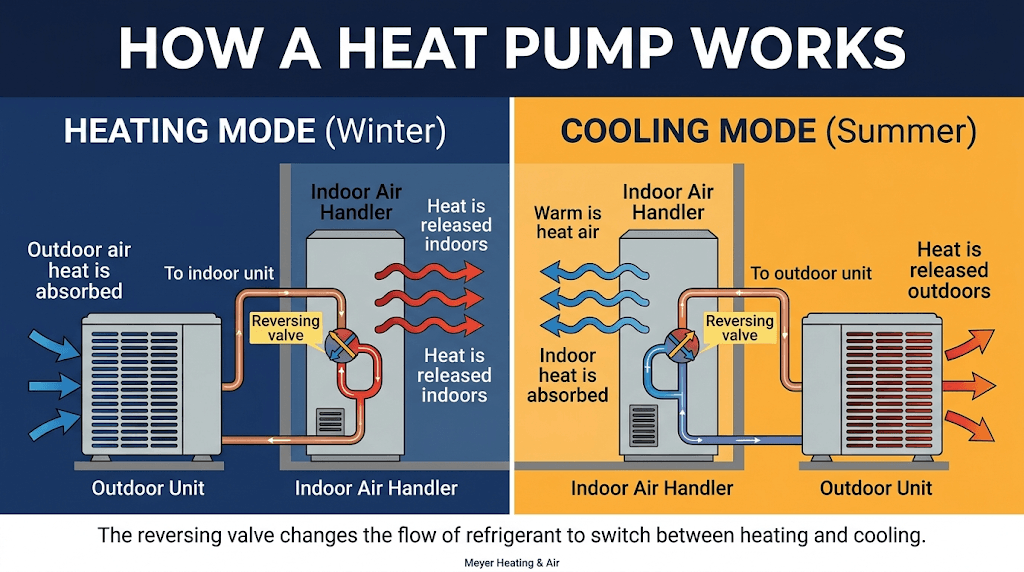
Now that you know the components, let’s look at how they work together during the different seasons. The reversing valve is the key to this dual-functionality, shifting the flow of refrigerant to match your comfort needs.
Heating Mode (Winter)
During the colder months, the heat pump extracts heat from the outside air and moves it indoors:
- Absorption: Cold liquid refrigerant passes through the outdoor coil. Because the refrigerant is extremely cold, it can absorb heat from the outdoor air, even when it is freezing outside.
- Compression: The compressor pressurizes the refrigerant, turning it into a hot gas.
- Release: The hot gas travels to the indoor coil. The blower fan pushes indoor air across the hot coil, absorbing the heat and distributing it through your home. As the refrigerant releases its heat, it condenses back into a liquid.
- Expansion: The liquid refrigerant passes through the expansion valve, dropping its pressure and temperature before heading back outside to repeat the cycle.
Cooling Mode (Summer)
During the summer, the reversing valve changes the refrigerant’s path, and the heat pump functions exactly like a standard air conditioner:
- Absorption: Warm indoor air is pulled across the indoor coil. The cold refrigerant inside the coil absorbs the heat and humidity, cooling the air before the blower fan pushes it back into your rooms.
- Compression: The now-warm gaseous refrigerant travels to the outdoor compressor, which increases its pressure and temperature.
- Release: The hot refrigerant passes through the outdoor coil. The outdoor fan blows air across the coil, releasing the absorbed heat into the outdoor environment.
- Expansion: The pressurized liquid refrigerant goes through the expansion valve, cools down significantly, and returns to the indoor unit to continue cooling.
Differences Between an Air-Source Heat Pump and a Geothermal Heat Pump
While traditional air-source heat pumps move heat between your indoor air and the outdoor air, geothermal heat pumps (also called ground-source heat pumps) utilize the earth.
Heat Source
- Air-Source Heat Pump: Extracts heat from the outdoor air in winter and releases it into the air in summer.
- Geothermal Heat Pump: Uses the relatively constant temperature of the ground or a nearby water source (usually between 50 and 55 degrees Fahrenheit) to exchange heat.
Efficiency
- Air-Source Heat Pump: Highly efficient, but efficiency can drop during extreme cold spikes, sometimes requiring backup electric heat.
- Geothermal Heat Pump: Exceptional efficiency year-round. Because the ground temperature remains stable regardless of the weather, geothermal systems do not have to work as hard during extreme winter or summer outdoor temperatures.
Lifespan and Install
- Air-Source Heat Pump: Installed entirely above ground, often lasting 15 to 20 years with proper maintenance.
- Geothermal Heat Pump: Requires excavation to bury “ground loops” (underground piping). The indoor components last 20 to 25 years, while the buried loop can last 50 years or more. However, they carry a much higher upfront installation cost.
Heat Pump Geothermal Diagram
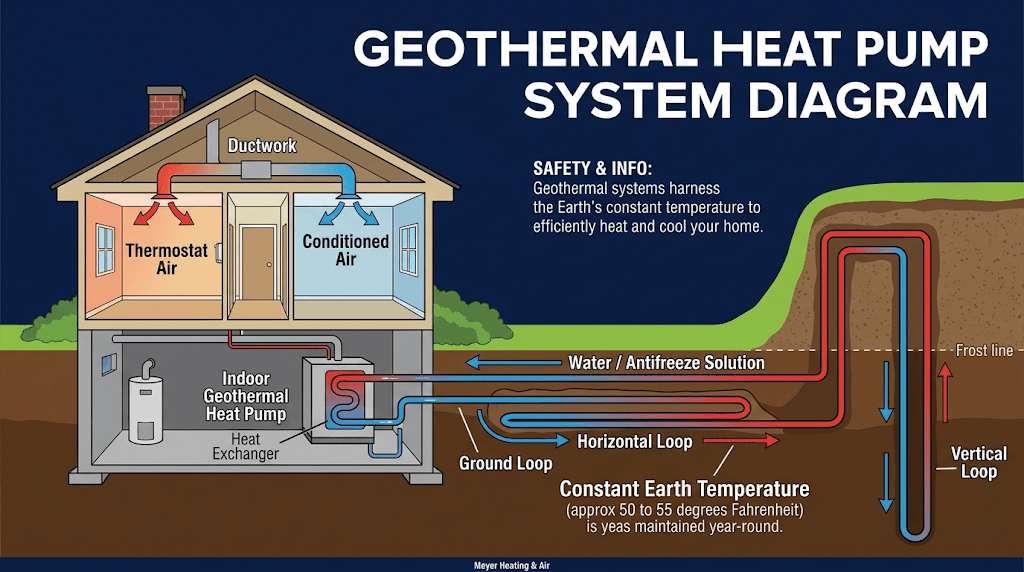
Geothermal systems rely on a network of underground pipes, known as a ground loop, to move heat. Let’s look at how these systems connect to your home.
Understanding the Geothermal Ground Loop
As shown in the diagram, geothermal heat pumps rely on a series of underground loops filled with a water and antifreeze solution:
- Closed-Loop Systems: These are the most common. Heavy-duty plastic pipes are buried either horizontally (in wide, shallow trenches) or vertically (in deep boreholes) on your property.
- Horizontal Loops: Best for properties with plenty of available land, where trenches can be excavated 4 to 6 feet deep to lay the piping.
- Vertical Loops: Ideal for properties with limited space or rocky soil. Boreholes are drilled 100 to 400 feet deep to accommodate the vertical U-bends.
- Heat Exchange: A liquid solution circulates through these underground pipes. In winter, it absorbs natural warmth from the earth and carries it to the indoor heat pump to warm your home. In summer, the process reverses, and the fluid deposits indoor heat back into the ground.
Troubleshooting Your Heat Pump Issues
If you ever experience issues with your heat pump, understanding the basic component layout can help you troubleshoot before calling a technician. Here are a few simple checks:
- Check Airflow: Make sure the indoor air handler’s filters are clean and that registers and return grilles aren’t blocked. Low airflow can cause the indoor coil to freeze.
- Inspect the Outdoor Unit: Ensure the outdoor unit is clear of leaves, dirt, or snow. A blocked outdoor coil cannot effectively absorb or release heat.
- Check Your Thermostat: Verify that the thermostat is set to the correct mode (Heating or Cooling) and that the temperature setting is active.
- Confirm Power: Ensure the outdoor disconnect switch and the circuit breakers in your main electrical panel are all turned on.
If your system still won’t run, or if you suspect a component failure like a bad compressor or a stuck reversing valve, it’s time to call in the professionals.
Contact Meyer Heating & Air for Professional Heat Pump Services
Whether you are looking to upgrade to a high-efficiency air-source heat pump, need routine seasonal maintenance, or require reliable repairs, Meyer Heating & Air is here to help.
Our certified technicians understand every part of these complex heating and cooling systems. Whether you need expert heating services in Creve Coeur or prompt air conditioning repairs in Collinsville, we deliver the trusted care you need to keep your home comfortable in any weather.
Contact us today at (314) 269-0148 or schedule your appointment online!
FAQ about Heat Pumps
Yes. Modern “cold-climate” heat pumps can extract heat from outdoor air even in temperatures well below zero degrees Fahrenheit. However, during extreme cold snaps, a backup heating source (like electric strip heat or a dual-fuel furnace) may occasionally activate to help maintain the desired indoor temperature.
Typically, you should inspect your indoor air handler’s air filter every 30 days and replace or wash it at least every 1 to 3 months, especially during heavy-use seasons (winter and summer).
Yes. When operating in cooling mode, the indoor coil becomes very cold, causing moisture in the air to condense on the coil and drain away. This natural dehumidification is an excellent benefit during humid Missouri summers.