

On November 25, 2026, the U.S. Army detonated degraded lead azide at the Iowa Army Ammunition Plant near Middletown, Iowa. Early readings were encouraging: the EPA reported zero airborne lead detected throughout the region, and it says sampling of air, soil and water will continue in the days ahead. Before the blast, the Army projected that lead dust would reach only a small part of northern Clark County, Missouri, on the Iowa border.
Still, if the furnace is running every hour, family is coming in for Thanksgiving, and the news has you staring at the return vent in the hallway wondering what it actually catches, that is a fair question. Here is the straight answer on what your HVAC filter does, what it doesn’t, and the steps that improve your home’s air any day of the year.
What we know about the Iowa detonation
- What happened: The Army detonated degraded lead azide at the Iowa Army Ammunition Plant on the morning of November 25, under an emergency permit issued by the U.S. EPA.
- Early readings: The EPA reported that its real-time air monitors showed zero detection of airborne lead throughout the region. These are early readings, and sampling continues.
- Missouri: Gov. Mike Kehoe said before the blast that he expected no significant health risks to Missourians, and said afterward that the mitigation appeared to have been successful.
- Illinois: Illinois EPA said Illinois is not expected to be impacted by the detonation plume.
- Near the plant: The Army told residents inside the evacuation zone to leave and others nearby to shelter in place.
For the latest results, follow the agencies directly: the U.S. EPA’s Iowa Army Ammunition Plant page, the Missouri Department of Natural Resources and Illinois EPA. St. Louis Public Radio is also covering the story.
What your HVAC filter can and can’t catch
Your furnace filter carries a MERV rating, short for Minimum Efficiency Reporting Value. Per the EPA, the rating tells you the minimum share of particles a filter captures in three size ranges:
| Filter rating | 0.3 to 1.0 microns | 1.0 to 3.0 microns | 3.0 to 10 microns |
|---|---|---|---|
| MERV 11 | at least 20% | at least 65% | at least 85% |
| MERV 13 | at least 50% | at least 85% | at least 90% |
You may have seen 99.97% quoted for air filters. That number belongs to HEPA filters, which the EPA says can theoretically remove at least 99.97% of particles 0.3 microns in size. It is a different standard from MERV.
The EPA recommends a home HVAC filter rated at least MERV 13, or as high a rating as your system’s fan and filter slot can accommodate, and notes you may need to consult an HVAC technician. That last part matters, because the right rating depends on your system. For a deeper look at ratings, see What Do MERV Ratings Mean for My St. Louis HVAC System? or our air filtration service.
Nothing here is a claim that a filter protects anyone from lead. For health guidance, follow the agencies above.
Five steps that help your home’s air any day
- Close up when outdoor air is poor. Agencies told people near the plant to keep windows and doors closed and set heating systems to recirculate. The EPA gives the same windows-and-doors advice for wildfire smoke.
- Seal the drafts. The EPA notes that outdoor air gets in through small openings, joints and cracks, and around closed windows and doors. Weatherstrip exterior doors, caulk gaps around window trim, and seal around the attic hatch.
- Change your filter on schedule, and make sure it seals. A filter that leaves gaps in its slot lets air slip around it. Here’s how often to change yours.
- Add a portable HEPA air cleaner where you sleep. Choose one sized for the room. The EPA notes that a higher clean air delivery rate (CADR) serves a larger area.
- Leave dust at the door. Take shoes off inside and damp-dust hard surfaces. Your HVAC filter only catches what’s moving through the air.
Have an AprilAire 210 filter? Your next one is changing
If your home has an AprilAire whole-house air purifier that takes the 210 filter, AprilAire is sunsetting that filter. Its replacement is the UK211: a new 3-inch MERV 11 filter with AprilAire’s TriPure technology, packaged with one-time upgrade rails that slide into your existing cabinet without tools.
- Same rating: MERV 11, the same as the 210, so the swap keeps your current rating. If your system can handle more, the EPA recommends MERV 13, and your technician can tell you whether yours can.
- Filter life: AprilAire rates it for up to 12 months between changes.
- Fit: It fits AprilAire 4-inch cabinets and 6-inch cabinets already converted to the 4-inch filter. A 6-inch AprilAire or Space-Gard cabinet that was never converted needs a different kit, so have a technician confirm before you order.
- After the upgrade: The rails are a one-time install. Future changes are the 3F211 filter on its own.
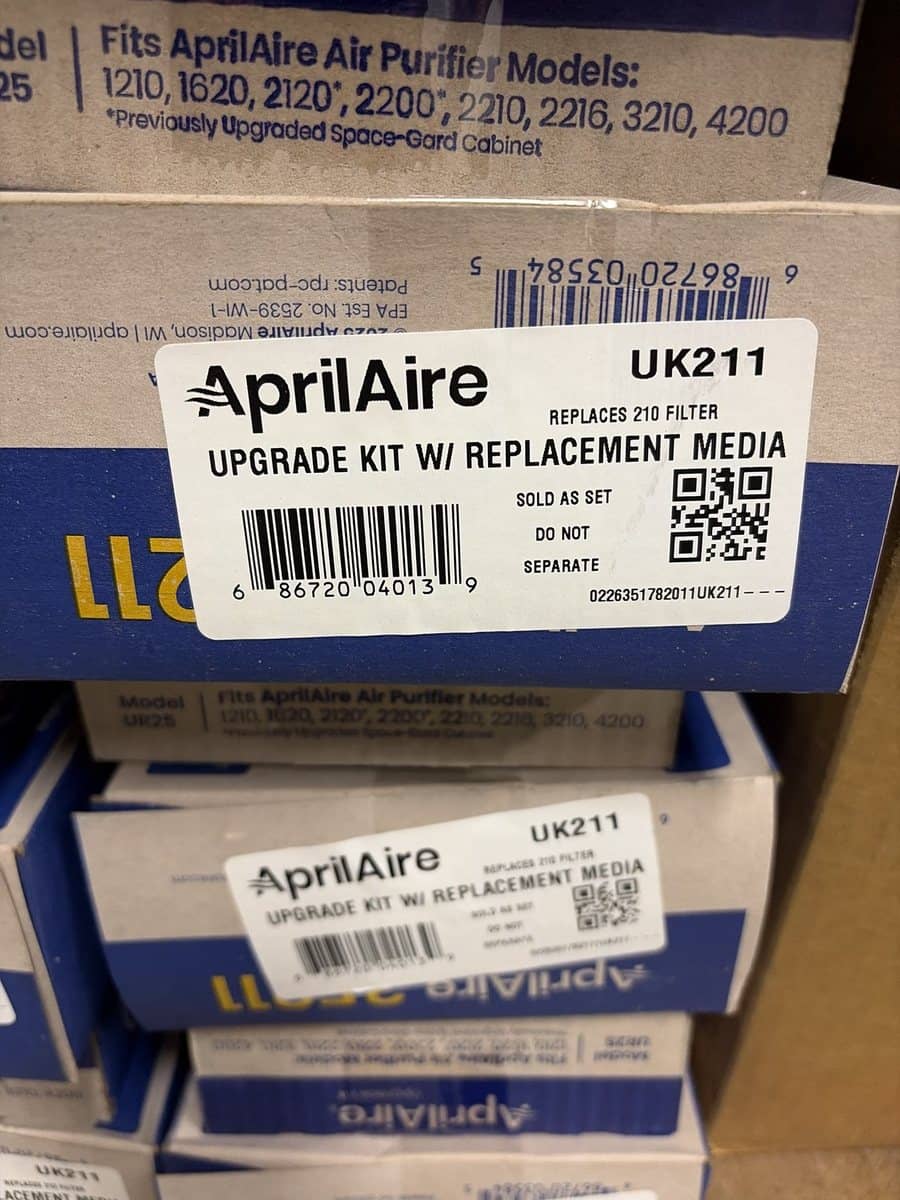
We keep UK211 kits on the shelf, so if your filter is due, your technician can make the swap during your visit.
Everyday air matters too
Lead is the headline this week, but St. Louis homes deal with airborne particles every day: pollen in the spring, pet dander year-round, dust from a long heating season, and the viruses that circulate every winter. The EPA says air cleaners and HVAC filters can help reduce airborne contaminants, including viruses, though filtration alone is not enough. A filter that fits your system and gets changed on schedule does that work every day.
Still looking at that hallway return vent?
If you would rather have someone look at it, a Meyer technician can check your filter and airflow during a maintenance visit, tell you which filter rating fits your system, and let you know whether your AprilAire cabinet is ready for the UK211. Book online or call (314) 845-1929.
Frequently asked questions
Did lead from the Iowa detonation reach St. Louis?
As of November 25, 2026, the EPA reported zero airborne lead detected throughout the region, and the Army’s pre-blast projection covered only a small part of northern Clark County, Missouri. Sampling continues.
Does a MERV 11 filter remove 99.97% of particles?
No. 99.97% is the HEPA benchmark for particles 0.3 microns in size. Per the EPA, a MERV 11 filter captures at least 20% of particles 0.3 to 1.0 microns, 65% of particles 1.0 to 3.0 microns and 85% of particles 3.0 to 10 microns.
Is the AprilAire UK211 a direct replacement for the 210 filter?
Yes. AprilAire lists the UK211 as the direct replacement for the 210 in its 4-inch cabinets and in 6-inch cabinets already converted to the 4-inch filter. It pairs a 3-inch MERV 11 filter with one-time upgrade rails.
What MERV rating does the EPA recommend for a home HVAC filter?
At least MERV 13, or as high a rating as your system’s fan and filter slot can accommodate.