

Estimated reading time: 10 minutes
When freezing winter temperatures arrive across the region, you rely on your heating system to keep your household safe and comfortable. Walking over to a supply register only to feel chilly air blowing across your face is one of the most frustrating experiences a homeowner can face.
A furnace is built to deliver steady, reliable warmth. When it blows cool or room-temperature air instead, the issue can range from a simple misconfigured switch on your wall to a worn-out mechanical component deep inside the heating cabinet.
In this guide, we will break down why your furnace blows cold air when the heat is turned on, look at fuel-specific causes across gas, electric, and oil systems, explore why units struggle at night or with clean filters, and outline the steps needed to restore dependable heat.
Why Is My Furnace Blowing Cold Air When the Heat Is On?
When your thermostat is set to heat, you expect hot air to flow through your ductwork. However, if your furnace is only blowing cold air, it is important to distinguish between air that is cold right at the start of a cycle versus air that never warms up.
Every modern furnace goes through an automated startup sequence. When the thermostat signals for heat, the blower motor often begins circulating air, and the inducer fan purges residual gases before the burners ignite. During the first sixty to ninety seconds of this cycle, the air coming through your vents may feel lukewarm or cool because the heat exchanger has not yet reached its operating temperature.
However, if your furnace continues blowing cold air for several minutes without warming up, or if the blower runs constantly while the heat remains off, your heating system has encountered an operational fault.
6 Common Reasons Your Furnace Is Blowing Cold Air
When diagnosing a heating failure, HVAC technicians evaluate several universal issues that affect forced-air furnaces. Here are six common reasons a furnace blows cold air.
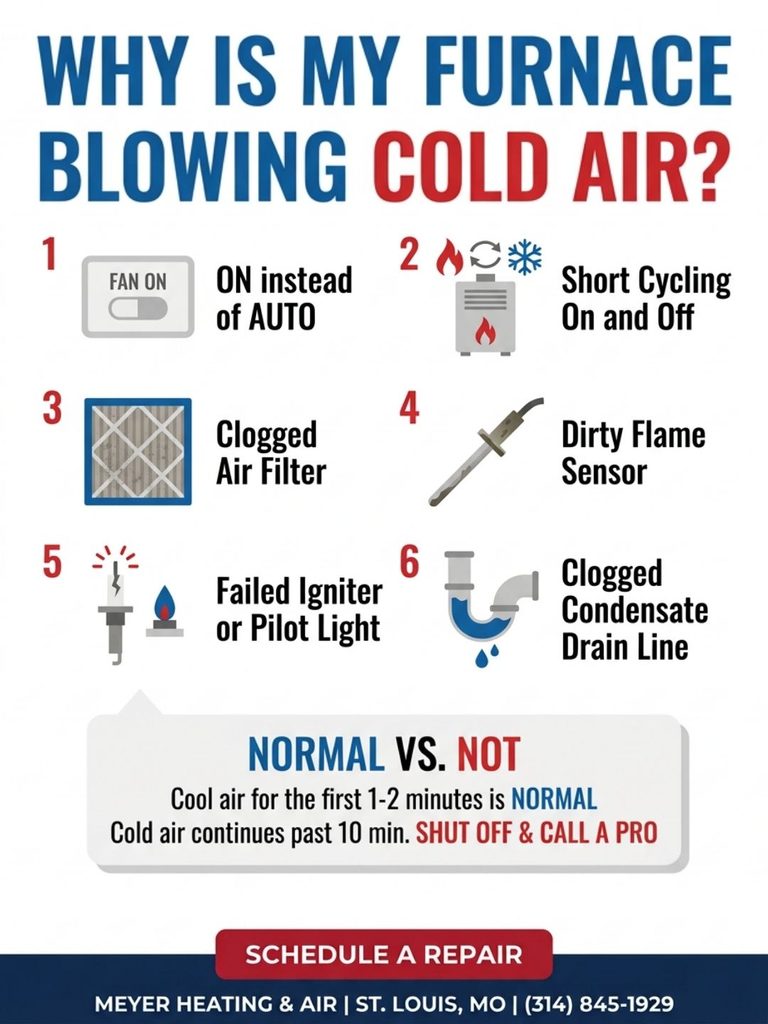
1. Thermostat Fan Setting Is Switched to ON Instead of AUTO
The most common reason a furnace blows cool air is an incorrect thermostat fan setting. Thermostats have two primary fan modes: AUTO and ON.
When set to AUTO, the system blower operates only while the burners or heating elements are actively generating heat. Once the house reaches your set temperature, both the burners and the blower shut down. When set to ON, the blower fan runs continuously twenty-four hours a day, even between heating cycles. When the burners cycle off, the fan keeps blowing unheated room-temperature air through your vents, making the air feel drafty and chilly. Switching the fan setting back to AUTO will solve this problem immediately.
2. Furnace Keeps Turning On and Off and Blowing Cold Air
If your furnace turns on, runs for two or three minutes, shuts down, and repeats this cycle continuously while circulating cold air, your system is short cycling.
Short cycling is a protective response. When internal temperatures inside the heating cabinet rise too high, a built-in safety sensor called a high limit switch trips, shutting down the burners while keeping the blower running to cool the equipment down. Because the burners shut off almost immediately, the system never has time to produce sustained heat, leaving your home cold.
3. Dirty or Clogged Air Filter Restricting System Airflow
A heavily restricted air filter is the leading cause of system overheating and short cycling. When thick dust, pet dander, and airborne debris coat the filter surface, air cannot pass freely across the heat exchanger.
Without sufficient airflow to absorb thermal energy, heat builds up rapidly inside the furnace cabinet. The high limit switch senses this extreme heat, shuts down the burners to prevent physical metal warping, and forces the blower to circulate unheated air until the heat exchanger cools.
4. Dirty or Malfunctioning Flame Sensor
In modern gas furnaces, the flame sensor is a narrow metal rod that sits directly in the path of the burner flame. Its job is to confirm that fuel has ignited safely.
Over multiple heating seasons, burning fuel coats the sensor rod in a thin layer of carbon crust and oxidation. This layer acts as an insulator, preventing the sensor from detecting the electrical current generated by the flame. If the control board does not receive confirmation that a flame is present within a few seconds of ignition, it shuts off the gas valve as an essential fire-prevention safeguard, leaving the blower fan running cold.
5. Faulty Electronic Igniter or Extinguished Pilot Light
Before any furnace can generate heat, fuel must be ignited. Older furnaces rely on a continuous standing pilot light, while modern systems utilize electronic hot surface igniters or direct spark assemblies.
If you have an older system and the pilot light goes out due to a draft or a worn thermocouple, the gas burners cannot ignite. On modern systems, hot surface igniters, which function like the filament in an incandescent lightbulb, become brittle over time and crack. If the igniter fails to glow red hot, the safety controls prevent the gas valve from opening, and the furnace will only blow unheated air.
6. Clogged Condensate Drain Line in High-Efficiency Units
High-efficiency condensing furnaces produce several gallons of liquid condensation every day during winter operation. This moisture drains through an internal plastic trap and an exterior PVC line.
If algae or dirt clogs this drainage line, water backs up into the internal drain pan or collector box. Condensing furnaces are equipped with an overflow float switch that cuts power to the ignition system as soon as water begins pooling. The blower fan often continues to run, but the burners will remain locked out until the drain pipe is cleared.
Why Is My Furnace Blowing Cold Air with a Clean Filter?
If you have already inspected your return grilles and verified that your air filter is brand new, your furnace can still blow cold air due to non-airflow problems:
Unconditioned Ductwork Leaks
If the ductwork running through an unheated attic, crawl space, or garage has disconnected seams or torn insulation, the system pulls freezing air directly from those unconditioned spaces into your air stream. Even if your furnace is producing heat, cold air entering the supply ducts dilutes the temperature, making the air coming out of your vents feel cool.
Gas Supply Interruption
If the manual gas shutoff valve along the supply pipe was accidentally bumped closed, or if the municipal gas supply was temporarily interrupted, the system cannot feed the burners. The furnace will attempt its startup cycle, fail to ignite, and enter a safety lockout mode with only the blower running.
Tripped Circuit Breakers on Split-Voltage Systems
Electric heating equipment often uses dedicated high-voltage double-pole breakers. If the breaker powering the heating element trips while the breaker powering the blower motor remains active, the fan will circulate cold air indefinitely.
Why a Furnace May Be Blowing Cold Air by Fuel Type
While all forced-air heating systems share similar distribution blowers, the mechanism that creates heat depends on the fuel source. Here is how cold air problems break down by equipment type.
Why Is My Gas Furnace Blowing Cold Air?
Gas units rely on precise fuel-to-air ratios and consistent ignition sequences. Beyond flame sensor oxidation and igniter burnout, gas systems blow cold air when the inducer draft motor fails to pull enough vacuum pressure. If the pressure switch detects poor chimney venting, it prevents the main gas valve from opening, leaving only the air handler running.
Why Is My Electric Furnace Blowing Cold Air?
Electric furnaces do not have burners or flues. Instead, they pass incoming air over heavy coiled metal elements, known as resistance heat strips. An electric unit blows cold air when:
- A Heating Element Burns Out: Electric furnaces use multiple heating elements staged in sequence. If one or more elements snap or burn through, total heat output drops dramatically.
- A Sequencer or Relay Fails: The sequencer staggers the activation of heating elements so the home electrical panel does not experience an enormous power surge. If a sequencer contact sticks open, the elements never receive electrical current.
- A Thermal Fuse Trips: If airflow drops, the electric element overheats and blows an internal one-time thermal fuse, cutting power to the heating coil permanently until replaced.
Why Is My Oil Furnace Blowing Cold Air?
Oil-fired heating systems feature distinct fuel delivery assemblies that require regular mechanical servicing. An oil furnace blows cold air primarily due to:
- An Empty Fuel Tank: If your heating oil supply drops too low, the burner pump draws air instead of liquid fuel, preventing combustion.
- A Clogged Oil Nozzle or Fuel Filter: Fuel oil contains microscopic sediment that settles at the base of the tank. Over time, this debris clogs the fuel filter or the atomizing nozzle, stopping fuel delivery to the combustion chamber.
- A Dirty Cad Cell Eye: Oil burners use a light-sensitive cadmium sulfide photocell, commonly called a cad cell, to verify that a flame is present. If soot coats the optical surface of the cad cell, the burner control shuts down within seconds of firing.
Why Is My Furnace Blowing Cold Air at Night?
Waking up in the middle of the night to cold air coming from your vents is a common complaint among homeowners. This issue is typically caused by three specific nighttime factors:
Smart Thermostat Night Setback Schedules
Many programmable and smart thermostats are set to lower household temperatures overnight to save energy. If the thermostat drops the target temperature five to eight degrees below daytime levels, the system will not call for heat until the room reaches that lower threshold. Meanwhile, if the fan is set to ON, it will blow cool room air continuously through the bedroom registers.
Freezing Condensate Lines Outdoors
For high-efficiency gas furnaces that vent condensation through an exterior PVC pipe on the side of your house, extreme nighttime temperature drops can cause liquid runoff to freeze solid at the pipe exit. The resulting ice dam backs up water into the furnace within hours, tripping the internal safety float switch and shutting down the burners in the middle of the night.
Strained Heat Pump Auxiliary Controls
If your home uses a hybrid dual-fuel system or a heat pump paired with an air handler, cold outdoor night temperatures reduce the heat pump’s natural output. If the electric auxiliary heat strips or backup gas stages fail to engage, the supply air will drop significantly below comfortable levels.
Trust Your Heating Repairs to Meyer Heating and Air
A furnace blowing cold air is more than just an inconvenience. In freezing weather, an unheated home risks frozen plumbing pipes, structural moisture condensation, and unsafe indoor living conditions. Diagnosing whether your heating problem requires a simple sensor cleaning, a new igniter, or electrical troubleshooting requires professional diagnostic furnace services.
At Meyer Heating and Air, our certified technicians bring decades of hands-on expertise to every heating service call. If your furnace is struggling to keep your family warm, our local team provides dependable furnace repairs in Chesterfield and prompt, comprehensive heating services in Kirkwood. We arrive quickly, determine the exact root cause of your heating breakdown, and restore steady, comfortable warmth to your home.
Contact Meyer Heating and Air today to schedule your furnace repair appointment and get your heat running right!
Frequently Asked Questions
How long should a furnace blow cold air before getting warm?
Under normal conditions, a furnace should blow lukewarm or cool air for no more than one to two minutes after starting up. Once the burners engage and the heat exchanger warms up, the air coming from your supply registers should rise quickly to between one hundred and twenty and one hundred and forty degrees Fahrenheit for gas furnaces, or around one hundred degrees for heat pumps.
Can a furnace blowing cold air be a safety hazard?
Yes, depending on the underlying cause. If a gas furnace is blowing cold air due to a cracked heat exchanger or incomplete combustion, it presents a potential carbon monoxide risk. Furthermore, leaving a furnace running while the burners continually short cycle can overheat the electrical control board and damage the blower motor.
Is it safe to leave a furnace on if it is only blowing cold air?
No. If your furnace continues blowing cold air for more than ten minutes without heating, you should turn the system to OFF at the thermostat. Leaving the system running wastes electricity, circulates cold drafts, and strains internal mechanical components while the heating chamber remains unlit.
How do I know if my flame sensor is bad?
The classic sign of a dirty or faulty flame sensor is a furnace that lights normally, burns cleanly for three to seven seconds, and then abruptly shuts off. If this sequence happens three consecutive times, the system will typically enter a temporary safety lockout mode.