


Estimated reading time: 11 minutes
During the height of summer, you depend on your central air conditioning system to maintain a balanced, refreshing indoor climate across every room in your home. Few things are as frustrating as walking from a comfortably chilled living room into a sweltering bedroom, or finding that your upstairs level feels like a sauna while your basement feels like an icebox.
Uneven cooling is a common comfort complaint among homeowners. While temperature differences can sometimes stem from everyday sun exposure or multi-story homes, they frequently signal underlying airflow restrictions, duct design flaws, or mechanical failures inside your cooling equipment. In this guide, we will break down the primary reasons houses experience uneven cooling, examine whether dirty ductwork is to blame, outline when professional AC repair is necessary, and explore solutions to restore balanced comfort across your entire living space.
Understanding Household Airflow and Temperature Balance
A central air conditioning system is designed as a closed-loop balanced network. The system pulls warm air from your living spaces through return grilles, routes it across a cold evaporator coil to extract heat and moisture, and pushes conditioned cool air back out through supply registers distributed throughout your home.
For this process to produce even temperatures from room to room, three conditions must exist simultaneously:
- Sufficient Air Volume: The blower motor must push enough cubic feet of air per minute across the cooling coils to reach the farthest supply registers in your floor plan.
- Sealed and Proportional Ductwork: The duct system must deliver air evenly without losing conditioned air into unconditioned spaces like attics, crawl spaces, or wall cavities.
- Proper Return Air Pressure: Air must be able to circulate back to the furnace or air handler freely without encountering closed doors or restricted return paths.
When any of these three pillars is compromised, cooling becomes inconsistent, leaving certain zones overheated while others stay chilly.
6 Reasons Your House Has Uneven Cooling
When diagnosing uneven temperature distribution, HVAC professionals evaluate several universal factors spanning home construction, air distribution, and mechanical performance. Here are six primary reasons your home experiences uneven cooling.
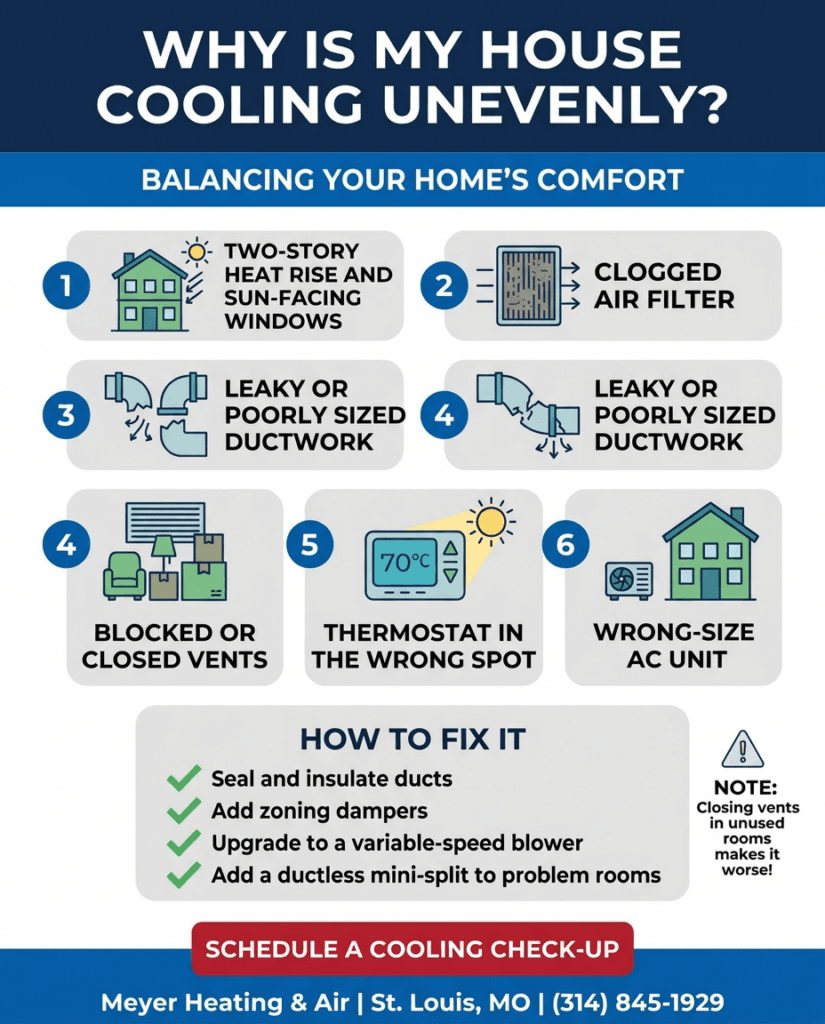
1. Multi-Story Layout and Natural Solar Heat Gain
Physics plays a natural role in how temperature distributes across a home. Warm air naturally rises while dense, cool air sinks to the lowest level. In two-story or three-story homes, heat from the entire house migrates upward, making upper bedrooms substantially warmer than the main floor.
Furthermore, rooms with large west-facing or south-facing windows absorb continuous solar radiation throughout the afternoon. Even if the air conditioner sends an equal amount of chilled air to every room, sun-drenched rooms require significantly more cooling to offset that heavy heat load.
2. Dirty or Clogged Air Filter Restricting Air Volume
A neglected air filter coated in dust, pet dander, and household lint is one of the most common causes of uneven temperatures. When airflow into the air handler is restricted, the blower fan cannot generate enough static pressure to push cool air through the longest duct runs.
Because the rooms farthest away from the indoor unit receive the least air volume under low-pressure conditions, distant bedrooms stay uncomfortably warm while rooms situated closest to the air handler receive adequate cooling.
3. Leaky, Disconnected, or Poorly Sized Ductwork
Ductwork hidden inside attics, basements, and crawl spaces can develop separated seams, loose joints, and torn flexible foil over years of seasonal expansion. According to energy efficiency studies, the average home loses twenty to thirty percent of its conditioned air through duct leaks.
If supply ducts run through an unconditioned attic space that reaches one hundred and thirty degrees in summer, any gap in the ductwork will suck in scalding air or let chilled air escape before it ever reaches your supply registers. Additionally, ducts that were improperly sized during original construction can choke air delivery to specific rooms.
4. Blocked, Closed, or Unbalanced Supply Registers
Many homeowners close supply vents in unused guest rooms or home offices under the mistaken impression that it saves money on utility bills. In reality, closing vents disrupts the delicate pressure balance inside your duct network.
Closing registers increases static pressure inside the ductwork, which strains the blower motor and forces air out through tiny sheet metal leaks rather than redirecting it to warm rooms. Furthermore, furniture, rugs, or long draperies placed over floor registers choke off airflow, preventing chilled air from circulating into the room.
5. Thermostat Placement and Single-Zone Limitations
Your central air conditioner takes its operating orders from a single location: your wall thermostat. If your thermostat is installed in a cool, shaded hallway on the first floor, it senses that the home has reached its target temperature and shuts down the cooling cycle.
Meanwhile, your upstairs bedrooms may still be six to eight degrees hotter than the thermostat setting. In a standard single-zone HVAC system without motorized dampers or remote temperature sensors, the cooling equipment simply cannot know that upstairs rooms are overheating.
6. Incorrectly Sized Air Conditioning System
Air conditioning equipment must be precisely calculated to match the square footage, window placement, and insulation levels of your specific structure. If an air conditioner is oversized, it cools the central areas of the home too rapidly and shuts down before running long enough to push air to distant rooms or dehumidify the space, creating a clammy, uneven indoor environment.
Conversely, an undersized air conditioning unit lacks the total cooling capacity to keep up with peak outdoor heat, resulting in weak airflow and hot spots across the entire perimeter of your home.
Is Uneven Cooling Due to Dirty Ductwork?
Homeowners frequently ask whether dirty ductwork is the primary culprit behind hot spots and uneven room temperatures.
While dirty ductwork can contribute to cooling imbalances, it is rarely the sole cause. Over decades of operation, heavy accumulations of dust, pet hair, and debris can settle along the interior walls of your supply and return lines. When this buildup becomes exceptionally dense, it creates internal friction that reduces air velocity, particularly in flexible duct runs that have sagging bends or pinched elbows.
However, dirty ductwork is usually a symptom of a larger underlying issue:
Compromised Duct Sealing
Heavy dust inside your ductwork often enters through unsealed joints located in dusty attics or unfinished basements. The same cracks that pull in dirt and insulation particles also leak chilled air into the attic, causing rooms at the end of that duct run to receive weak, lukewarm airflow.
Clogged Evaporator Coils
If dust bypasses your air filter and coats the cooling evaporator coil inside the air handler, airflow across the entire system drops dramatically. The dirty coil cannot absorb heat effectively, and the blower motor struggles to move air past the obstructed fins, starving distant vents of cooling capacity. Routine air conditioner maintenance helps keep the coil clean before dust builds up.
While professional duct cleaning clears airflow restrictions and improves indoor air quality, solving uneven cooling permanently usually requires pairing duct cleaning with professional duct sealing and airflow balancing.
When an AC Repair May Be Necessary
While adjusting register louvers and swapping out air filters are easy DIY maintenance steps, persistent hot spots often indicate that your cooling equipment has suffered a mechanical breakdown. Here is when professional AC repair is required:
Low Refrigerant Levels Due to a System Leak
Central air conditioners rely on a sealed closed-loop circuit of chemical refrigerant to pull heat out of your living space. If a leak develops in the copper tubing or evaporator coils, system pressure drops.
As refrigerant escapes, the cooling capacity of the air conditioner plummets. While the vents closest to the indoor air handler may still feel faintly cool, rooms farther away receive air that has lost its cooling power, resulting in widespread hot spots and extended run times.
Failing Blower Motor or Run Capacitor
The blower motor in your indoor unit is responsible for circulating air through every supply register in your home. As blower motors age, bearings wear down, windings overheat, and electrical run capacitors lose their capacitance. A weakening blower motor spins at lower speeds, generating insufficient static pressure to push cool air to the far corners of your floor plan.
Frozen Evaporator Coils
When airflow drops or refrigerant levels run low, the moisture condensing on your indoor evaporator coil can freeze into a solid block of ice. Once the coil freezes over, air cannot pass through the metal fins. The air conditioner will run continuously, but very little air will emerge from your registers, causing temperatures inside your home to spike rapidly.
Malfunctioning Motorized Zoning Dampers
If your home utilizes a multi-zone HVAC system with separate thermostats for different floors, the system relies on motorized dampers inside the ductwork to direct airflow. If an electric damper actuator fails or a damper blade gets mechanically stuck in the closed position, that entire zone will be deprived of cool air regardless of your thermostat commands.
Effective Solutions to Fix Uneven Cooling
Restoring balanced, reliable cooling across every room in your home requires targeted solutions designed to address airflow, ductwork, and equipment performance. Here are four effective solutions to eliminate temperature imbalances and restore consistent comfort across your house:
Install a Multi-Zone HVAC System
Adding motorized duct dampers paired with dedicated thermostats allows you to control temperatures independently on each floor or wing of your home. When upstairs rooms warm up from intense solar heat gain, the motorized dampers channel extra conditioned air directly to that level while reducing airflow to naturally cooler areas like basements, completely eliminating upper-floor heat buildup.
Seal and Insulate Duct Runs
Having a certified HVAC technician test your duct system and apply professional mastic sealant or aerodynamic aerosol sealing eliminates conditioned air loss. Sealing leaks prevents chilled air from escaping into sweltering attics and hot attic air from being pulled into your living spaces. Adding high-grade insulation around duct runs in unconditioned zones ensures air stays ice-cold until it reaches the farthest supply registers.
Upgrade to a Variable-Speed Blower System
Variable-speed air handlers and modulating compressors adjust their operating capacity dynamically rather than running at a single, all-or-nothing pace. By running longer, ultra-efficient cooling cycles at lower speeds, a variable-speed system provides continuous, gentle air circulation. This constant air mixing prevents temperature stratification, removes significantly more indoor humidity, and eliminates stubborn hot spots.
Add Ductless Mini-Split Systems to Problem Rooms
For bonus rooms over garages, finished attics, sunrooms, or home additions that your main central air conditioner struggles to cool, installing a ductless mini-split delivers customized, high-efficiency cooling directly to that zone. Ductless systems operate with their own dedicated thermostat and indoor air handler, giving you precise temperature control without requiring an expensive overhaul of your existing duct network.
Restore Balanced Comfort with Meyer Heating and Air
Living with hot bedrooms and drafty living areas makes summer weather stressful and compromises your indoor comfort. Identifying whether your uneven cooling stems from simple duct static pressure issues, leaky attic runs, or a failing blower motor requires specialized airflow diagnostic tools and certified expertise.
At Meyer Heating and Air, our experienced technicians bring decades of hands-on technical craftsmanship to every cooling challenge. If your air conditioner is struggling to keep your entire household comfortable, our local team provides prompt ac repairs in Ballwin and comprehensive cooling services in Kirkwood. We arrive quickly, test static pressures across your ductwork, inspect your equipment, and deliver reliable solutions to keep every room in your home cool and refreshing.
Contact Meyer Heating and Air today to schedule your air conditioning repair appointment and enjoy even, balanced comfort all summer long!
Frequently Asked Questions
Why is the second floor of my house always hotter than the first floor?
The second floor is naturally hotter because thermal energy rises, meaning heat from the first floor moves upward into upper rooms. In addition, the roof absorbs intense solar heat throughout the day, transferring that thermal energy straight through the attic and ceiling into upper bedrooms. Without a zoned HVAC system or dedicated duct booster, standard single-system units struggle to overcome this natural heat load.
Does closing vents in unused rooms help cool the rest of the house?
No. Closing supply registers increases static pressure inside your duct system, which causes air leaks, strains the blower motor, and can cause the indoor evaporator coil to freeze over. To maintain proper airflow balance, keep at least eighty-five to ninety percent of all household supply vents fully open.
Will a register booster fan fix a hot room?
A register booster fan installed in a floor or wall vent can help draw a modest amount of extra air through a long duct run. However, booster fans only treat the symptom rather than the disease. If the ductwork is disconnected, leaking in an unconditioned attic, or choked with debris, a booster fan will only pull warm or dusty air into the room.