

During freezing winter cold snaps, your furnace works tirelessly to keep your home warm, balanced, and comfortable. Inside every gas, propane, or oil heating system sits a critical component that works entirely behind the scenes to keep your family safe: the heat exchanger.
While the heat exchanger is engineered to withstand intense thermal cycles, decades of continuous expansion, friction, and moisture can compromise its structural integrity. Recognizing the subtle warning signs of cracked heat exchanger failure is critical for every homeowner, as heating contractors widely consider this one of the most serious mechanical hazards an HVAC system can experience.
In this comprehensive guide, we will break down what a heat exchanger does, what causes a cracked heat exchanger, what a crack looks like, how to identify distinct warning smells, whether a crack can cause carbon monoxide poisoning or fire, how technicians check for damage, and whether a cracked heat exchanger can ever be safely repaired.
What Is a Heat Exchanger and How Does It Work?
To understand why a crack is so dangerous, it helps to understand how a furnace creates heat. When your furnace burners ignite, burning fuel generates intense heat alongside hazardous combustion gases, including carbon monoxide, sulfur dioxide, and nitrogen oxides.
The heat exchanger consists of a series of curved metal tubes or chambers positioned directly above the burners. The burning fuel circulates through the interior of these metal chambers, heating up their outer walls before the toxic exhaust gases exit safely through your chimney or PVC flue pipe.
Simultaneously, your indoor blower fan pushes return air across the exterior surface of these hot metal chambers. The air absorbs the thermal warmth from the metal and travels into your living spaces as clean, heated air.
Under normal conditions, a sealed physical barrier separates the toxic exhaust gases inside the heat exchanger from the breathable air flowing through your home. A crack destroys that barrier, allowing dangerous combustion byproducts to leak directly into your household airflow.
What Causes a Cracked Heat Exchanger?
Heat exchangers do not crack randomly without cause. Damage typically stems from chronic operational strain, poor maintenance, or natural component aging. Here are the primary reasons why a heat exchanger develops cracks:
Severely Restricted Airflow and Clogged Filters
Restricted airflow is the leading cause of premature heat exchanger failure. When an air filter becomes choked with pet dander, dust, and debris, or when homeowners close too many supply registers, the blower cannot push sufficient air across the metal chambers.
Without adequate air volume to absorb thermal energy, internal temperatures inside the heating cabinet spike to dangerous levels. The steel coils expand far beyond their engineered tolerances, weakening the metal until hairline fractures appear along stress curves and welded seams.
Frequent Short Cycling
If an oversized furnace or a faulty thermostat causes your system to turn on and off rapidly, the heat exchanger undergoes continuous, violent cycles of rapid heating and rapid cooling. This constant expansion and contraction places severe mechanical fatigue on the metal, causing the seams to split over time.
Condensation and Corrosion
In high-efficiency gas furnaces, the combustion process produces mildly acidic moisture. If the condensate drainage lines, collector box, or internal traps become blocked, acidic water pools inside the secondary heat exchanger. Over multiple heating seasons, this acid eats away at the metal, causing rust perforations and corrosion holes.
Natural System Aging and Wear
Even with clean filters and optimal airflow, every furnace has a finite mechanical lifespan. The average residential gas furnace lasts between fifteen and twenty years. After tens of thousands of thermal cycles over nearly two decades, the steel walls naturally thin and become brittle, making cracking almost inevitable in aging units.
What Does a Cracked Heat Exchanger Look Like?
Homeowners often imagine a cracked heat exchanger as a large, gaping break in the furnace cabinet. In reality, a cracked heat exchanger is rarely that obvious to the untrained eye.
Because the heat exchanger is tucked deep inside the furnace chassis behind the burner assembly, draft inducer, and blower compartment, viewing the metal directly is nearly impossible without dismantling the cabinet. When examined by a technician, visual signs of cracked heat exchanger damage typically present in one of several forms:
- Hairline Stress Fractures: Microscopic cracks that run along the curved bends of the metal tubes where thermal expansion is most severe. These cracks may remain tightly shut when the metal is cold, but they spread open as soon as the furnace warms up and expands.
- Separated or Split Welds: Cracks that form along the factory weld lines connecting the metal clamshell halves or tube joints.
- Rust Crust and Flaking Metal: Heavy patches of orange, brown, or white oxidation along the lower curves of the heat exchanger tubes. Rusted metal becomes paper-thin and eventually flakes away, leaving small holes.
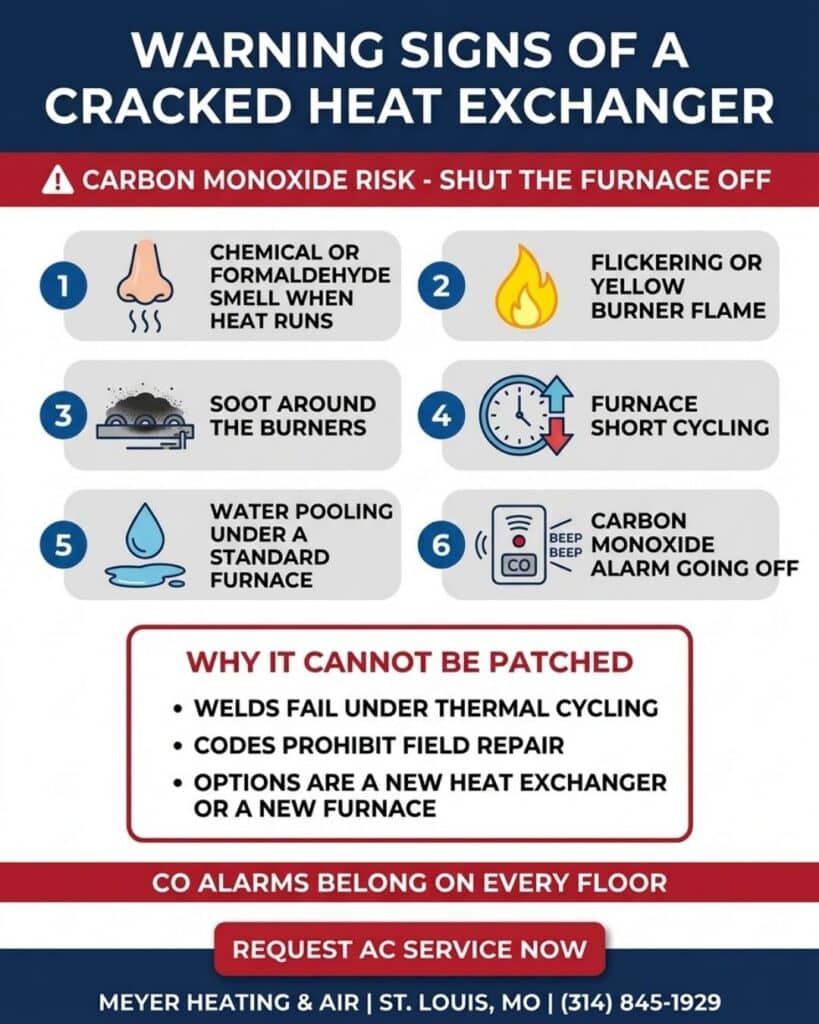
- Soot Accumulation: Black, powdery carbon residue gathering around the burner ports, interior cabinet baffles, or draft hood. Soot indicates incomplete combustion caused by distorted airflow inside the heating chamber.
Cracked Heat Exchanger Smell: What Does It Smell Like?
One of the most noticeable warning signs of cracked heat exchanger problems is an unusual, persistent odor when the heat turns on.
Carbon monoxide itself is completely colorless, odorless, and tasteless. However, the other combustion byproducts that escape alongside carbon monoxide carry strong, distinct smells. Homeowners dealing with a cracked heat exchanger frequently describe the odor in three distinct ways:
- A Strong Formaldehyde or Pickling Smell: The most common scent associated with cracked heat exchangers is a sharp, pungent chemical smell resembling formaldehyde. This odor is caused by aldehydes, which are chemical byproducts of incomplete fuel combustion circulating into the room air.
- Sulfur or Rotten Egg Smells: While raw natural gas contains mercaptan to smell like rotten eggs, an exhaust leak from an incomplete burn can also produce a faint, noxious sulfur odor.
- Burning Metal or Electrical Odors: When internal temperatures inside the cabinet become excessively hot due to restricted airflow and metal fatigue, homeowners often smell scorched dust or overheated metal.
If you ever detect an unfamiliar chemical or exhaust odor when your heat runs, shut down the furnace immediately and schedule an inspection.
Critical Dangers: Carbon Monoxide and Fire Risks
Because the heat exchanger manages active fire and poisonous fuel exhaust, any structural failure poses immediate health and safety hazards for your household.
Can a Cracked Heat Exchanger Cause Carbon Monoxide?
Yes, a cracked heat exchanger is one of the leading causes of carbon monoxide poisoning in residential properties.
When the furnace blower fan kicks on, it generates high static air pressure around the outside of the heat exchanger. This pressure difference can force room air into the crack, disrupting the combustion flame and causing incomplete fuel burning, which generates elevated levels of carbon monoxide.
At the same time, carbon monoxide and other toxic gases leak through the fracture and mix directly with the air pushed through your household vents. Exposure to carbon monoxide can cause headaches, dizziness, nausea, disorientation, and even fatal poisoning. Every home with fuel-burning equipment should feature working carbon monoxide alarms on every floor.
Can a Cracked Heat Exchanger Cause a Fire?
Yes, a cracked heat exchanger can cause a house fire.
A cracked heat exchanger disrupts the delicate draft pressure inside the combustion chamber. When air leaks into the burners from the blower compartment, it can blow the flame backward out of the front of the burner box, an effect known as flame rollout.
Flame rollout pushes raw fire against interior furnace wiring, plastic switches, and the metal cabinet itself. While modern furnaces incorporate rollout safety switches designed to cut power when flames escape, electrical switch failures or persistent rollout can ignite surrounding drywall, utility framing, or nearby storage items.
Can You Run a Furnace with a Cracked Heat Exchanger?
No, you should never run a furnace with a cracked heat exchanger.
If an HVAC technician identifies a crack, hole, or seam separation in your heat exchanger, industry safety standards and local building codes require the technician to disable the unit and shut off the gas supply. Operating a damaged furnace puts everyone inside the home at continuous risk of carbon monoxide exposure, electrical damage, and fire.
If you suspect your heat exchanger is damaged, turn the system to OFF at your thermostat and keep it powered down until a licensed professional evaluates it.
How to Check for a Cracked Heat Exchanger
Because the internal chambers of a heating system are sealed inside a metal cabinet, diagnosing the physical signs of cracked heat exchanger failure requires specialized technical training and diagnostic instruments.
Subtle Warning Signals Homeowners Can Spot
While homeowners cannot perform physical heat exchanger pressure tests themselves, you can look for these external clues:
- Flickering or Jumping Burner Flames: Look through the furnace inspection glass when the burners ignite. The flame should burn steady and blue. If the flame flutters, dances, or turns yellow the moment the indoor blower motor starts up, air is leaking through a crack and disturbing the combustion chamber.
- Frequent High Limit Safety Tripping: If your furnace turns on, runs for three minutes, and shuts off before warming your home, the equipment is likely overheating due to restricted airflow or internal metal damage.
- Water Pooling Around a Standard Furnace: While high-efficiency condensing furnaces produce condensation naturally, standard-efficiency units should never leak water. Water pooling beneath an eighty percent efficient unit often indicates severe chimney draft issues and corroded heat exchanger tubes.
Professional Diagnostic Testing Methods
Certified HVAC technicians use rigorous testing procedures to verify heat exchanger damage:
- High-Definition Borescope Cameras: Technicians insert flexible, lighted fiber-optic cameras through high-limit sensor holes and burner openings to inspect internal welds, bends, and metal surfaces for hairline fractures.
- Electronic Combustion Gas Analysis: A technician places a digital probe inside the exhaust flue to measure oxygen, carbon dioxide, and carbon monoxide levels. Significant fluctuations in combustion efficiency when the blower fan turns on provide definitive proof that air is crossing between the heat exchanger chambers.
- Static Pressure and Airflow Testing: Technicians measure static duct pressures and temperature rises across the supply and return drops, confirming whether chronic overheating has caused structural stress.
Can a Cracked Heat Exchanger Be Repaired?
Homeowners often ask whether a cracked heat exchanger can simply be welded, patched, or sealed. The answer is unequivocally no. A cracked heat exchanger cannot be repaired.
Heat exchangers are subjected to extreme thermal expansion, expanding when hot and contracting when cool. Any weld, braze, or mechanical patch applied to the metal will quickly crack or fail under the intense thermal cycling. Furthermore, heating equipment manufacturers, the American Gas Association, and local building codes strictly prohibit field-welding heat exchangers due to the extreme danger of carbon monoxide leaks.
When a heat exchanger cracks, you have only two viable options:
1. Replacing the Heat Exchanger Assembly
If your furnace is relatively new, typically under eight to ten years old, and the heat exchanger is still covered under the manufacturer limited parts warranty, replacing the assembly may be an option. While the metal part itself may be covered for free, the homeowner must pay for technical labor. Replacing a heat exchanger requires completely dismantling the furnace, which takes five to eight labor hours and typically costs between twelve hundred and twenty-five hundred dollars.
2. Full Furnace Replacement
If your furnace is over twelve to fifteen years old, investing thousands of dollars in technical labor on an aging unit is rarely practical. Old blowers, gas valves, and control boards are also approaching the end of their lifespan.
Investing in a modern high-efficiency furnace provides a brand-new heat exchanger, ten or twenty-year factory warranties, upgraded safety controls, and lower monthly heating bills.
Protect Your Household Comfort with Meyer Heating and Air
Spotting the warning signs of cracked heat exchanger failure is a serious safety priority that demands fast, accurate diagnostics from experienced heating professionals. Determining whether an unusual odor or flickering burner flame stems from a simple sensor issue or a dangerous structural fracture requires advanced combustion analyzers and certified craftsmanship.
At Meyer Heating and Air, our certified technicians bring decades of hands-on expertise to every home comfort challenge. If you suspect your furnace is struggling, our local team provides dependable furnace repairs in Ellisville and premier heating and cooling services in Ballwin. We arrive promptly, conduct comprehensive combustion and visual safety inspections, explain your options clearly without high-pressure sales tactics, and restore safe, reliable warmth to your home.
Contact Meyer Heating and Air today to schedule your furnace diagnostic inspection and ensure your family stays safe and warm all winter long!
Frequently Asked Questions
What are the earliest signs of cracked heat exchanger damage?
The earliest warning signals usually include unusual chemical odors that smell like formaldehyde or aldehydes when the heat turns on, burner flames that flicker or turn yellow once the blower fan activates, soot gathering near burner ports, and unprompted carbon monoxide alarm alerts.
Will a carbon monoxide detector go off if my heat exchanger is cracked?
Not always. Standard residential carbon monoxide detectors are designed to sound an alarm only after elevated levels of carbon monoxide persist over several hours, typically above seventy parts per million. A small hairline crack may release low concentrations of carbon monoxide that linger between ten and thirty parts per million. While this level may not trigger a basic store-bought alarm, it can still cause chronic headaches, fatigue, and health risks over time.
What are the symptoms of carbon monoxide poisoning from a furnace?
Common symptoms of carbon monoxide exposure include dull headaches, dizziness, nausea, shortness of breath, unexplained fatigue, and confusion. If multiple family members experience these symptoms at the same time, or if pets appear unusually lethargic, evacuate your home immediately and call emergency services.
How much does it cost to replace a cracked heat exchanger?
On average, replacing a heat exchanger costs between twelve hundred and twenty-five hundred dollars in technical labor and materials. If the unit is no longer covered by an active manufacturer parts warranty, the price can exceed three thousand dollars, making a complete furnace replacement the more economical choice.